So much has happened since the last time I updated that this entry is likely going to be a big splurgy mess, trying to summarize everything:
- I sprained my knee on the dance floor on Corey's birthday night out at the Crystal Ballroom, during 80's night. For a week I could barely walk. However, as of today I'm walking normally, and went to yoga class this morning, the first thing remotely resembling physical activity (other than walking or limping as fast as I could to the Max) that I've done in the past week. Hurting my knee has been a chronic injury since I first sprained it playing basketball in high school; this is at least the third time I can remember it popping out of its socket. I think I'm going to be fine. I'll do some strength-building exercises and continue taking my housemates joint power-building vitamins (he's a weightlifter).
- Corey and I spent four days in New Orleans for French Quarter festival. It was wonderful. I tried making a list of everything I ate but it was too long. Highlights included alligator sausage, turtle soup (delish), grilled oysters (or maybe they were clams? I dunno, but they were AMAZING), crawfish and goatcheese crepes, spicy gumbo, incredibly buttery BBQ shrimp, ("there's some shrimp in your butter!" Corey told the cook), beignets, and an enormous crawfish and crab boil that Corey's uncles dumped all over a table covered in newspapers (we diligently worked our way through it, occasionally sweeping the piles of carcasses we accumulated into a bucket on the floor). Basically the whole weekend belonged to thisiswhyyourefat.com. It was wonderful. I ate so much garlic it reeked through my pores for 24 hours.I forgot to pack the camera, but his mom sent Corey some photos, so maybe I'll post those on the long-neglected travel blog.
- I was offered the Kiva Fellow position after a lengthy application process. So it looks like for 10 weeks (maybe more) in the fall Corey and I will be somewhere in Central or South America and I'll have the chance to opportunity here. Hopefully I'll find out about my placement as soon as possible... it hasn't really sunk in at this point.
So here's what the rest of the year is staring to (tentatively) look like: I'll be leaving my current job before I journey with Corey to England for two weeks, from August 17th to September 2nd, in order to visit family for the first time in three years. From September 9th to the 20th I'm thinking about doing 10-day vipassana meditation retreat. From September 21st to the 25th I'll need to be in San Francisco for training, and I'm thinking maybe I can cram some time a couple of days afterwards to visit friends in California (Ana? Cara? Leah and Kyndall? At least Grandma, if nothing else)...
Then I'll need to depart for my placement any time between October 1st and the 15th (it's pretty flexible, thankfully so). If I end up placed in South America, Corey and I still have that return ticket to Ecuador that we never ended up using, so maybe we could fly to Quito and then just bus our way to wherever. It probably won't work out that way because our flight date will fall on a year after we bought it (September 17th '08), so they'll probably charge us a chazillion bucks to change it. Yuck. Well, we'll figure it out!
This week sees the arrival of many friends visiting from afar: Los Angeles, France, Connecticut... I think my brain and heart might self-implode from happiness. Today so far: went to yoga class and did some grocery shopping, ate a yummy spinach-lettuce salad with oranges and balsamic vinegar, had a cup of super Irish english breakfast tea, read blogs about babies (don't worry, I'm not getting any ideas, I just got trapped by how weird and alien and fascinating they were) and listened to Ani DiFranco's latest album online. Happiness. Now it's time for laundry...
Saturday, April 25, 2009

Sunday, April 12, 2009
People Who Don't Know the Answers

If I could write fiction like any author, I'd want to write like Anne Tyler. The first Tyler novel I ever read was Saint Maybe, which my sister checked out of the Colegio Bolivar library. It's the same copy I have with me now; I guess one of us in an act out of an audacious sense of entitlement must have stolen it. If you look at the little flap of paper in the back (how old-fashioned and antique that seems now!), where the librarian would stamp the due date under FECHA DE VENCIMIENTO, the earliest date is 24 March 1998—more than ten years ago! Next to the due date we were supposed to write the grade we were in (who knows why), so there is also a historical record of the changes in my sister's handwriting as well as mine. The small squat sixes of sixth grade, the taller and more elegant eights of eighth grade. A single thin nine. I guess it was after ninth grade, once we realized that we were the only people checking the book out, over and over again, that we decided that we were the proper owners of the book. Sorry, Bolivar library, forgive us! If it's any consolation/defense, it has definitely found a loving home in our bookshelves.
I started re-reading Anne Tyler at exactly the right time. I've been sick since Sunday with an upper respiratory tract infection. TMI Warning I've been producing all this absolutely grotesque green phlegm, with the consistency of yogurt End TMI. It's equal parts fascinating and disgusting—I am kind of amazed that something like this could come out of my body. On Friday night I took some Dayquil, drank some Visoda and bravely went out on the town with Corey for a birthday night of dancing at the 80's dance night at the Crystal Ballroom. In the middle of "Burning Down the House," I slipped on a puddle of water and dislocated my left knee, the same knee I've been injuring chronically since high school. This is at least the fourth time it's been sprained. It's much better today than yesterday, but it still feels weird, all stretched and unsteady. I'm taking Matt's joints rehabilitation vitamin pills and icing it a lot. I can sort of hobble now, which is a big improvement.
Thus it feels like subconscious psychic foreshadowing on my part that I had the foresight to check out all these Tyler novels last week, like The Accidental Tourist and Dinner at the Homesick Restaurant. I re-read Tourist , lived vicariously through Macon's injury and recovery and am now plunging eagerly through Dinner, which I'm not sure if I've ever read completely. I have this weird deja-vu feeling reading it, so I'm thinking that maybe I started reading it at some point, but just never finished.
There is something so wonderful and comforting about an Anne Tyler novel. When I'm keeping an injured leg elevated about heart level to encourage reduced swelling while reaching for the roll of toilet paper and hacking my guts out, I can't think think of any other author I'd rather read. "The perseverance of human beings suddenly amazed him," realizes one of the characters in Dinner. It's this perseverance and doggedness that Tyler is particularly skilled at highlighting. Or as a character in Tourist observes,
'You ever wonder what a Martian might think if he happened to land near an emergency room? He'd seen an ambulance whizzing in and everybody running out to meet it, tearing the doors open, grabbing up the stretcher, scurrying along with it. 'Why,' he'd say, what a helpful planet, what kind and helpful creatures.' He'd never guess that we're not always that way; that we had to, oh, put aside our natural selves to do it. 'What a helpful race of human beings,' a Martian would say. Don't you think so?'
It's just really nice to read books about people who are genuinely trying to be good, even if their actions don't always make it seem that way. Tyler has a lot of love for her characters and it shines through in a way that makes me think of that famous quote about Salinger, that he loved his characters more than God loved them. (Further research led me to learn that this quote was by John Updike, and was meant as a criticism of Salinger. I never liked your writing anyway, Updike.)
Saint Maybe particularly hit home for me at this point in my life, mainly because it's about a character who spends most of the book taking care of children who are not his own. Ian's wry observations about taking care of children had me nodding my head vigorously, yes, yes:
He wondered how people endured children on a long-term basis—the monotony and irritation and confinement of them.
You could never call it a penance, to have to take care of these three. They were all that gave his life color, and energy, and... well, life.
It wasn't easy. A lot of it was just plain boring. Just providing a warm body, just being there; anyone could have done it. And then other parts were terrifying. Kids get into so much! They start to matter so much. Some days I felt like a fireman or a lifeguard or something—all that tedium, broken up by little spurts of high drama.
The other part of the book that drew a straight line between my heart and the pages were the sections about the incertitude of knowing. A lot of the book is about learning how people who seem to "know all the answers" really, well, don't. In fact, nobody does. Understanding the meaning of someone or something in your life is eventually understood as something that's ultimately impossible to do:
Apparently, he thought, there were some people in this world who simply never came clear. Reverend Emmett, Mr. Brant, the overlapping shifts of foreigners... In the end you had to accept that the day would never arrive when you finally understood what they were all about. For some reason, this made him supremely happy.
It's the "happy" part that's key. Ian's main conflict in this book is kicked off by the "arrogant certitude" with which he informs his brother that his wife is cheating on him. At the time, he feels like he definitively "knows" this as a fact, but over time he has to admit that no, he really doesn't know it at all. More than anything else, this book seems to me now to be about surrendering that need for possessive control, to "know" how things are and how things are going to turn out. In the opening pages, Ian is described as someone who is always imaginng his life as seen from a distance, as observed by an outsider:
There were moments when he believed that someday, somehow, he was going to end up famous. Famous for what, he couldn't quite say; but he'd be walking up the back steps or something and all at once he would imagine a camera zooming in on him, filming his life story. He imagined the level, cultured voice of his biographer saying, 'Ian climbed the steps. He opened the door. He entered the kitchen.'
This passage really hit home for me with a particularly sharp pang because I used to do the same thing as a really little kid. I'd make lists of all the novels I was going to write. Sitting on the toilet or high up in the mango tree in the yard, I'd talk to myself and answer questions about my life, pretending I was being interviewed on a talkshow or by a reporter. Yeah, I was a particulary imaginative kid, but more than that, I had this ambitious, feroscious drive in me that I had to *BE* someone, you know? My ego was a hungry-hungry-hippo, and it wanted to feed. It still does.
I've been doing a lot of thinking about ego lately (thanks Siddhartha!). When you graduate from college, you're really forced to think about what you want to do in a grandiose, epic fashion: "so are you going to be one of those people who are going to *BE* somebody??" the ego hungrily, greedily chatters at you. "You're not just going to waste and fritter your days/years away, right? You're going to *DO* something, right?? You're going to be GREAT!!" Sometimes this voice is helpful, because it can drive you to do things you wouldn't normally do. Other times, it can be quite exhausting. Your ego is always demanding knowledge, knowledge, knowledge, defitive plans, facts, schedules. Sometimes you just can't have that in life, though.
In Saint Maybe, another one of the main lessons that Ian learns is about "leaning into his burden." About viewing it as a gift, rather than a weight. This is the only life you'll have. So you might as well not get stressed out about things, you know? Next week I won't be working as a prestigious research assistant with a really important professor in a well-known university, but I will be building submaries with third graders. And for now, that's enough. It's enough for now to listen to Alex Murdoch's "Orange Sky" and the Dixie Chicks' "Travelin' Soldier" on Corey's pandora country music station and daydream about the piece of bread with melted cheese I'm about to get up and make myself in a minute. Maybe this afternoon I'll work on some applications for some potentially cool summer/fall stuff. And maybe learn the Higitus Figitus.
"The best thing for being sad," replied Merlin, beginning to puff and blow, "is to learn something. That's the only thing that never fails. You may grow old and trembling in your anatomies, you may lie awake at night listening to the disorder of your veins, you may miss your only love, you may see the world about you devastated by evil lunatics, or know your honour trampled in the sewers of baser minds. There is only one thing for it then — to learn. Learn why the world wags and what wags it. That is the only thing which the mind can never exhaust, never alienate, never be tortured by, never fear or distrust, and never dream of regretting.”--T. H. White, The Sword in the Stone (found on Slate's The Happiness Project blog, my latest fascination/addiction)
Saturday, April 4, 2009
The emerging monster: La casa verde

At first I tried reading this book in Spanish. After 3 weeks I'd read about 50 pages. Depressed and defeated, I conceded by putting down La casa verde and picking up The green house. (Trans. Gregory Rabassa. New York: Harper, 1968.)Reading it in English wasn't that much easier, but at least I wasn't looking up all these jungle-related and boat navigation terms at WordReference every 10 seconds.
It took me a while to realize that the structure of the book is like the film 21 Grams: a lot of cutting back and forth between scenes from the past and from the future, and it's only until you're well into the book that you learn the chronology. Umberto Eco said that he was aware that the first hundred pages of The Name of the Rose were the hardest, because he wanted the act of reading to be like an initiation ritual for the reader: like the monks, the reader was meant to be immersed in this really stressful, dense experience that makes you wonder “My God, how am I going to be able to get all the way through this?” Thankfully enough (as tends to be the case for these sorts of books) once you get used to the language and the structure, it's relatively smooth sailing. I'm definitely left with the feeling that I'm going to have to read this again, in order to let all of its nuances and complexities sink in properly. For the time being, I'm going to offer up this paltry review.
Overall, I'm very impressed by the narrative structure and writing style of La Casa Verde. Mario must have had post-its stuck all over his desk in order to keep track of the chronology (or who knows, maybe even he isn't completely sure of it). This would be an ideal book on which to write a dissertation because there's a lot of stuff to unpack in here. Civilization vs. barbarity (modernity vs. savagery) is obviously a big one. There's a lot of scenes of people's eyes floating greedily over beads, jewels and rubber, feeling that Sacred Hunger. Most of the relationships between people originates from commerce and trade. The main character is an Indian girl called Bonificia, who is kidnapped from her family by the military and nuns in the opening scene of the novel. If I had to say what this novel is about in one sentence, I'd have to say it's about Bonificia, and how she goes from living “saved” by the nuns to becoming a prostitute called Wildflower. Her story reminded me a lot of Pocohantus in The New World, especially in the scenes involving her relationship with her shoes.
There's another narrative thread involving Fushia, a guy with Japanese ancestry who runs away with this girl called Lalita and they end up living in the jungle together, and their dealings with Aquilino, an old man who rides his boat up and down the jungle river and trades canned goods and weapons for rubber with the Indians. There's a group of four friends who go to a bar. I'm not even going to get into the criminal gang led by this master boat captain Nieves because I'm not sure I fully understood it. And then lurking in the background above it all is the story of the Green House, how it was founded by this mysterious guy called Don Anselmo, who reminded me of Jewel from As I Lay Dying in the beginning, frolicking about on his horses, but turns into this withered lonely old man. He remains very much an enigma to the end. One of the characters call him “the one who brought civilization to Piura.” Whether that civilization is good or bad is a whole 'nother bag o' beans.
The important thing about all of these characters is that none of them are depicted as bad guys. Fushia is a little deplorable in his treatment of Lalita in the jungle, but he probably doesn't deserve the fate he ends up with (not many people would). Even the nuns have a sympathetic scene with Bonificia. Near the very end of the novel, after a description of a torture scene that sheds a lot of light in events earlier in the book, someone describes the Captain involved: “He had his weaknesses, like any human being, Don Pedro: but on the whole he was a good person.” (361) I see a lot of parallel themes between La casa verde and Sacred Hunger, especially concerning the question of how far will humans go in their treatment of each other in order for material goods.
The blind girl that Don Anselmo (the founder of the titular Green House brothel) has a relationship with is also very intriguing. The fact that she's blind isn't just in itself interesting, but the way she got blind—I don't want to spoil it—let me just say that it was grisly enough for me to put the book down for a minute, and that the blind girl is essentially a corpse come back to life. During one of Don Anselmo's monologues, he says a few things that I think may be quite key to the whole work:
And you didn't realize, you I'm so stupid, how terrible not to understand, sweet, never knowing what's going on with you, unable to guess. And there, again, your heart is like a fountain, and the questions, her sparkling, what do you think I'm like, and the inmates, and their faces, and the ground you're walking on, where does what you hear come from, what are you like, what do those sounds mean, do you think that everybody is like you?, that we hear and do not answer?, that somebody feeds us, puts us to bed, and helps us upstairs?
I found the question raised by this passage particularly relevant to some of the topics I touched upon in the previous post: how do we go about relating with other people? "How terrible not to understand," indeed. It's all the more pertinent since the book itself is difficult to understand, and Vargas Llosa obviously knew that. The most obvious example is the dialogue that's written without any breaks or signs to indicate that it is in fact two different conversations taking place at two different points at time (I hope that makes sense). By doing so, Vargos Llosa appears to be challenging the reader's concept of the "present"--that when we read, we are reading events in a certain order. In The Green House the present is all mixed up. What a provocative word, the present. Living in the present moment is difficult. And yet it's what a lot of us are striving to do. I spent a lot of time this weekend really sick from yet another cold (I am officially clipping a bottle of hand sanitizer this week) and spent a lot of time in bed reading blogs about meditation retreats and ashrams. There's so many people out there, trying to figure out the secret behind truly living in the present. It's no wonder that novels that mess with time feel particularly meaningful.

In this talk by Vargas Llosa, he discusses how in colonial times (back when the Spanish were still tramping all over Latin Americ), the language of novels was seen as this intensely subversive force. The two greatest forces in colonial Latin America were the church and the military, and the language endorsed by both didn't have much space for language in which signs were muddled and unclear. Novels were seen as frivolous, sinful even—a language of lies. It was the kind of environment where Don Quixote had to be smuggled over from Spain in the bottom of wine barrels in order to reach South American audiences. Reading a novel back then must have evoked an illicit thrill; the experience must have been a lot like reading Orwell's “1984” in Burma today. I think one of the things Vargas Llosa is trying to do in La casa verde is evoke that same subversive power that the novel must have had back then, through using this innovative language.
I am definitely going to read this book again someday. I feel like I'm just skimming the surface of the potential ideas and theories it has to offer about human nature, language and literature. Right now I can see what elements and ideas stuck out for me; in the future it'd be cool to develop a theory and argument in more detail.
Medidating on the word "present" immediately brought to mind a passage from Virginia Woolf's "The Waves" that I memorized for a final exam, way back in 2007.I feel like it is connected to the mission of this blog (specifically concerning the attempt to connect "the present moment" to poetic forms) in some vitally important yet oblique way:
"It is the first day of the summer holidays. And now, as the train passes by these red rocks, by this blue sea, the term, done with, forms itself into one shape behind me. I see its colour. June was white. I see the fields white with daisies, and white with dresses; and tennis courts marked with white. Then there was wind and violent thunder. There was a star riding through clouds one night, and I said to the star, 'Consume me.' That was at midsummer, after the garden party, and my humiliation at the garden party. Wind and storm coloured July. Also, in the middle, cadaverous, awful, lay the grey puddle in the courtyard, when, holding an envelope in my hand, I carried a message. I came to the puddle. I could not cross it. Identity failed me. We are nothing, I said, and fell. I was blown like a feather. I was wafted down tunnels. Then very gingerly, I pushed my foot across. I laid my hand against a brick wall. I returned very painfully, drawing myself back into my body over the grey, cadaverous space of the puddle. This is life then to which I am committed."
"This I say is the present moment; this is the first day of the summer holidays. This is part of the emerging monster to whom we are attached."
Tuesday, March 31, 2009
On Learning
I've been thinking a lot these days about the value of curiosity. During our early getting-to-know-you conversations, I asked Corey how he would describe himself in one word, and he said, "curious." (I didn't know my one word at the time, but now I think it would have to be "dreamer.") But then I just think about this innate curiosity within me and damn, maybe I am just stupid and naive and this is going to get me into trouble, but the joy of wandering lost through the PQ sections of the SE stacks in the Hauser Library, writing book reviews in my stupid blog, rambling with my co-workers about Borges, or just reading, reading, reading, underlining passages, thinking, writing--it brings me a great joy I don't get anywhere else. No one can take that curiosity away from me, you know? It's in me, it is me. I'll always have it. If I have a way to use it, to the best of my ability, I will be happy. And all these ridiculous badges that supposedly constitute prestige and success can never hold a candle to that, ever.
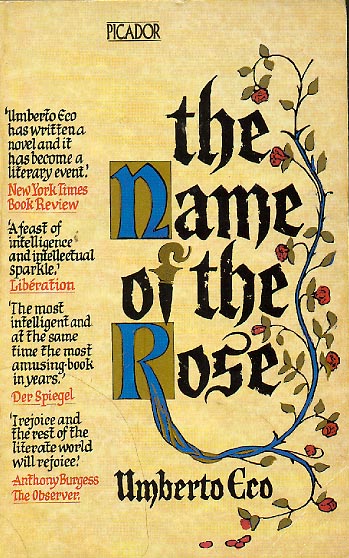
This has been an introspective year for me so far. Having lots of time on the Max to read will do that for ya, I guess. One of the things I've been thinking about lately is the role of books in my life. I just finished Umberto Eco's The Name of the Rose, one of the most glaring titles on my list of Books I Really Should Have Read Already, Don't Know Why I Haven't, Really. In this case, I think it's for the best I waited this long. I definitely got a lot more out of this book with an undergraduate degree.
For one thing, I've read a lot more Borges now than I had in high school, which makes certain aspects in TNOFR like the blind librarian and the labyrinth in the library stand out a lot more (read more about the connection between Borges and Eco here). The introduction is puro Borges and Nabokov, especially in the fictional translator's cheerful pronouncement that the volume lacks any relevance for our present day. Another benefit of my undergraduate education are the lit theory classes, which makes the book's discussion of the roles of signs a lot more interesting. The part where William identifies the abbot's horse (by means of the tracks he left behind in the snow and the flustered monks pursuing him for example) is really ingenious, demonstrating (in William's view) how the universe speaks to us quite clearly through signs. The main question that he (and Borges, and Nabokov) grapple with is how to interpret those signs—is there any order to them, other than the flimsy order imposed by our own minds to make our surroundings seem meaningful? (Probably not.) What is the value of interpretation? Can it ever arrive at any definitive truth, or will it just go on and on forever? (Probably yes. But that's not to say that some interpretations are more valuable than others—read Eco's thoughts on this here, an interesting talk that may be a little confusing if you haven't read his books.)*
The other thing I found unexpectedly intriguing in TNOTR was its discussion of “simple people.” I'd just re-read “Siddhartha” for the first time since high school a couple of weeks ago, and Hesses uses the same term, to refer to people who are purely controlled by their desires. That is to say, people who go through life controlled by what they want: get a job, get money, get married, get a house, get a big TV, get a nice car, and so on. Most of the people in the world are like this—not that there's anything wrong with that. It is vital to note that a major part of Siddhartha's enlightenment is that he eliminates his judgment for the “simple people,” and instead of thinking that his way is superior or vice-versa, he simply accepts that they are different. It is not wrong to be one of the “simple more” any more than it is better to be someone like Siddhartha's—they're just different. The ending of “The Curious Case of Benjamin Button” reiterates the same message: “Some of us are dancers, some of us are mothers, etc,” Brad Pitt intoned solemnly in a voice-over. Or as my Grandma Mary is fond of saying, “We're all different, Julie—different strokes for different folks.”
In The Name of the Rose, the “simple people” are discussed in context to how words affect them, in the sense that they can be more easily manipulated by language. People like William are more akin to a class of readers, because he's constantly trying to read the signs around him, as opposed to accept them at face value. Not to sound incredibly arrogant and place myself on the same level of Sherlock Holmes, but I like to think that it's the same drive in me that inspires me to plough through an entire Phillip K. Dick book in one day, or stubbornly struggle with Mario Vargas Llosa's La Casa Verde. I can think of a lot of people who would think it was pretty crazy to spend my time trying to read Ulysses and La Casa verde. In a way, it is kind of silly. But to me, it feels incredibly valuable and important and precious and there is really no other way I'd rather spend my hours here on Earth: thumbing through these books, inhaling them into their brain, thinking about their words, wondering about their effects and their relation, among each other, among societies, and with me. If I had to describe myself in one word, it would be “dreamer.” I'm just not settled yet, you know? A lot of us aren't. Me, I have little clouds floating out of my ears...
I've been trying to think of a way to explain why books are so personally appealing to me, mainly because my co-workers keep asking me how I liked majoring in literature, and I always respond immediately that I loved it, that it was great, and then my answer to their follow-up question of “why?” is always hopelessly confabulated. Here's one of the reasons I came up with: I was thinking that one of the things you will never be able to do while you are alive on this earth as a human being is to see yourself through another people's eyes. You are always going to be you, indefinably and inexhaustibly you, tied to the ego of your self, your memories, your desires, all the little building blocks that construct you as a person (many of which you are probably not even aware of—maybe that's what life is for, trying to figure out what those tiny little building blocks are). As close as I am to people like my sister and Corey, I'm never going to know what it's like to *be* Corey—to be inside his head, to see the world as he sees it, to know what he's thinking at any random moment. There's this really interesting part in Wizard of the Upper Amazon where during his shaman training, the main character drinks ayahuasca in many ceremonies and learns what it's like to be different animals: anacondas, jaguars, pink river dolphins. At one point he goes inside the mind of everyone in the tribe, and this experience helps him become an especially emphatic and alert healer. Thus, therein lies some of the magic of reading. On one level, reading purports to allow you to “see” the world through another's eyes. I will never know what it's like to be an Italian monk in the 13th century, trying to solve a seemingly unsolvable mystery. But goddamn, I probably know more now that I would have if I'd never read it. Reading is a gateway, a vehicle to different experiences that I otherwise would never be able to have.
Another joy of TNOTR was recognizing myself in the characters. Yes, I definitely cackled to myself, nodding vigorously in recognition as I thumbed eagerly through the pages—yes, these crazy library people, “men who live among books, with books, from books”--these are my people. As one of the monk puts it, “It's true. We live for books. A sweet mission in this world dominated by disorder and decay.” (112) In contrast to the “simple” people, the monks are presented as the “learned' population, living the so-called life of the mind. (I'm glad that my experience of living the life of the mind didn't end with me drowning in a barrel of pig blood, though it came pretty close at times.)
This discussion of having a certain privileged “learned” population who are particularly good at interpreting makes me slightly uneasy, because to me it automatically raises the question of authority: what happens if authoritative interpretations, as designed by this select group, gets in the way of individuals interpreting for themselves? I'm not necessarily thinking of grad school students taking over the world. In one provocative section, Adso discusses learning as something for the few and elect - “Learning is not like a coin, which remains physically whole even through the most infamous transactions; it is, rather, like a very handsome dress, which is worn out through use and ostentation. Is not a book like that, in fact? Its pages crumble, its ink and gold turn dull, if too many hands touch it.” (185) Comparing learning to a book that can grow shabby, decayed and eventually crumble from overuse sets up the biggest danger in the end of the novel—namely, people who think that it's better off if certain kinds of learning (found in specific books) are kept solely to themselves, even if it meant having to kill to keep it secret. William has an interesting monologue in which he discusses the problem of giving learning to the simple:
"The simple have something more than do learned doctors, who often become lost in their search for broad, general laws. The simple have a sense of the individual, but this sense, by itself, is not enough. The simple grasp a truth of their own, perhaps truer than that of the doctors of the church, but destroy it in unthinking actions. What must be done? Give learning to the simple? Too easy, or too difficult. The Franciscan teachers considered this problem... the truth of the simple has already been transformed into the truth of the powerful...How are we to remain close to the experience of the simple, maintaining, so to speak, their operative virtue, the capacity of working toward the transformation and betterment of their world?"
Since for William, “the experience of the simple has savage and uncontrollable results...” his solution is that “we must be sure that the simple are right in possessing the sense of the individual, which is the only good kind.” (205) I can see a lot of sense in that. Being a living individual is a unique, singular experience. I will never know what it's like to be you, you will never know what it's like to be me. That's something that really shouldn't get lost--this understanding and appreciation of our unique, singular existence. Nobody quite like you, with your thoughts-visions-dreams, has ever existed, nor will ever exist again. Even if the kids I work with every day don't turn out to be graduate students or university professors, they nontheless deserve to think of themselves as *individuals* who can decide for themselves what they want. They don't have to go into the Army just because that's the authorative interpretation of what they should do with their lives imposed upon them--they are individuals with unique personalities and thus unique decisions (I think you could argue that authorities try to erase this, in order to encourage only one interpretation). I'm probably not making this point as clearly as I want to... but in summary, this book helped me figure a couple of important things out, in unexpected ways. I think I'm slowly but surely coming to terms with my own decentered nature, my detective-like character, my unsettledness, and I'm slowly but surely beginning to learn how I can use those qualities as a gift, not just to better others, but also myself. I may not be any closer to creating any more order in this world, but at least there is the smallest semblance of more order in this poor head of mine.
“Learning does not consist of knowing what we must or we can do, but also of knowing what we could do and perhaps should not do.” (97)
* There's an absolutely crazy anecdote in this talk straight out of Philip K. Dick, where Eco describes an incident in which he found himself living a scene straight out of TNOTR: thumbing through a beat-up old book in his library, its pages stuck together in a gluey fashion, and realizing it was this lost, incredibly valuable translation of Aristotle. This really blew my mind. There is something crazy going on with this whole life-imitates-art business...
Sunday, March 22, 2009
The Empire Never Ended

Man, it's been hard for me to feel relaxed lately! It's been a little hard for me to figure out why...
1 – I have first-day of school anxieties about running the Mad Science camps during spring break at the B&G Club this week. Oh, it just goes on and on, doesn't it? Trying to get the printer to work so that I can print out the instructions. Finding the time with Corey at some point this week to make sure I actually know how to build a bottle rocket before I go about trying to teach 30-40 children how to do so.
2 – This has been true for the past week or so, but lately it feels like the long commute is really getting me down. When I take the Max from my house (as opposed to downtown), it takes me an hour and a half to get to work, as opposed to forty minutes. An hour and a half!! That's something like 15 hours a week, just spent sitting on the Max, to and fro. That's like another part-time job, right there. I dunno, I never really planned on doing this job forever, just because it's neither all that challenging or well-paid. It's good for now; it's definitely better than nothing. I mean, the people with master's in education who work there and get paid just as much as me definitely helps puts things in perspective re: the current job market economy blah blah blah. And if that doesn't do it, then the chirping crickets and tumbleweeds blowing through the job postings on craigslist and idealist will definitely do it for ya.
3 – I applied for a fellowship to work/volunteer abroad, but apart from that I really haven't been doing anything. I mean, I check Americorps every week, craigslist every couple of days... I feel like I'm making an effort to keep looking. There's some journalism internships in D.C. and a non-profit internship in San Francisco that look interesting, but the idea of moving to these brand new expensive cities for an unpaid position just makes me feel like stale jam on the inside. The deadline to teach in Spain still hasn't passed. I dunno, I'm not really into applying for things just for the sake of applying for them anymore (though that's how I got this job and got saved from unemployment). I guess I'm going to just keep doing what I'm doing: keep my eyes open, scan things once a week but not really get too stressed out about it. If I don't get the fellowship Corey and I might just take off to South America and WWOOF it for a while.
4 – #3 is tied in with #4, the whole thinking/pondering/reflecting about the future (I don't want to put worry! Why worry, right?). I think a lot of this general anxiety may have to do with the fact that Laura is thesising, and so she's pretty much constantly stressed out and/or on very little sleep. I was talking to Emily on the phone the other day and I said that when I think about my spring break last year, I almost feel like I have PTSD: my heart starts pounding, my mouth tastes slightly acidic, my hands feel trembly like I've drunk too much coffee, I feel nervous for no discernible reason. Maybe it's because Laura is thesising that I've inevitably started thinking about mine. I dunno, I was reading some Onetti short stories and I picked up Faulkner's The Wild Palms... long story short, I need to easier on myself.
I am trying to learn about my “self” and what that “self” is.... I dunno, in my postmodern fiction class we talked a little about how modernity can really fracture and damage the self... I think the term I ended up using the most in my papers was the “decentered” self. That sounds about right: something not in its right place, teetering uneasily on the edge. And then in some of my yoga classes, the teacher mentioned thinking about our “divine” selves. All this sounds really woo-wooh, but bear with me a little. It was such a mind-blowing, weird concept to me: this idea that I have this self inside of me who is already perfect, already full formed, and the point of my life is to gradually and carefully peel away as many layers as I can in order to get as close to this perfect self as possible. I think of someone who is calm, mostly happy every day, peaceful and positive and satisfied with herself and life. Yeah, this is the self I am trying to approach.
It is so weird to try to think about this “self” in me. It's like trying to get to know a stranger. I'm like asking this self, so what do you do? Are you a writer? An academic? Do you teach in a university? Do you sit at home with your garden and write novels with your laptop in your lap? Do you teach English in a foreign country? Do you work as a journalist and write articles with sharp precise language about important issues? What do you do? What do you want? I want to reach the point where I know this person well enough to greet them as a friend, as opposed to an enemy or uneasy awkward acquaintance, when the day arrives. It t is all really very mind blowing, indeed.
It's hard to balance thinking about things in the long-term, but then also doing the day-to-day stuff that is necessary. Putting healthy food in your belly. Trying (unsuccessfully for two days now) to get your computer back from your boyfriend's sister, after you left your bag in your car, so that you can finally get started on revising your silly nanowrimo, which is so silly, but god help us, you find it so fun and fulfilling and entertaining anyway. Working the day job, making money so that you can pay your rent so that you can live with your lover and save up money to visit your parents in South America and your family in England. My grandmother just turned 93 in January and I really, really need to go see her. My aunt and uncle lost their house to the bank, victims of foreclosure. Yeah, family is important. No matter the anxiety that capitalism trains us to feel when our checking or savings account is suddenly and drastically emptier. What am I saving this money for, if not to go see friends and family now?
This really hit home in a powerful way:
you are going to have to go on a kind of journey.
You're going to have to do certain things and trust that answers will come to you. That involves letting go of a certain amount of control. It involves not doing what you have been doing. It involves change.
I mean, I'm confident that you're going to be fine, and I'd like you to trust me on that, but I'm not saying it will be easy, because lurking in this issue are some subtle concepts about the self and the world that you can only really get through emotional experience.
Just sit with your dreams and desires. Exempt them from the feasibility study. Regard them with interest. Allow yourself to feel the way you feel about them.
This sounds really woo-woo. But, hey. There is no shortcut. You're going to have to head in a new direction.
It takes courage to set out doing things in a new way. You're not going to know, right away, exactly where you're headed. So I suggest that you visualize, or dream, or speak from the heart, or sketch on a piece of paper, what you actually want -- where you want to be right now, what you want to be doing, what you want to own. I guess, eventually, if you find that you really want certain things, then you will be allowed to move to the stage of getting them. But for now, my opinion is that you have been doing too much getting and not enough wanting. So stick to wanting for a while. See if that doesn't relieve some of the anxiety about getting. Let go of getting. Just stick with wanting.
Wednesday, March 18, 2009
Deep Rivers Run Still

Before moving on to different topics of interest, I want to discuss one last book that takes the political versus the personal as one of its themes. I read Jose Maria Arguedas' Los Rios Profundos (Deep Rivers) in Spanish because I really missed reading in Spanish, and I wanted to make sure I could keep it up to par. At first I was worried I was going to have trouble getting into the book because it reminded me a lot of something we would read in Ms. Aguirre's tenth-grade Spanish class (not that there's anything wrong with that). I thought it was just going to be another coming-of-age novel, which it is, very much so. Now that some time has passed for me to reflect on it a little more, I'll go out on a limb and say that it's worthy of being mentioned in the same breath as Joyce's Portrait of the Artist.
The first half of the book is mostly episodic in nature. It's with the last few chapters (the ones dealing with the indigenous women's strike and the plague that afflicts the community) that the book really comes together, and all the seemingly disparate elements (the mad women, the various school friends and their dramas, the interactions with the indigenous community) suddenly click together into a cohesively, thematically-related whole. This makes sense, since it's these two events (the strike and the plague) where Ernesto the narrator really comes together as a person. Beforehand, he's very much a watcher, an observer. When the strike happens, he gets much more involved, and once the plague hits he's a drastically more active character.

You can read more about Arguedas in his biography, but basically Los rios profundos is an fictionalized version of Arguedas' childhood. Like the main character Ernesto, Arguedas' father was a country lawyer who traveled a lot, and apparently whenever he was away from home Arguedas' stepmother would lock him up in the kitchen and ignore him, so essentially he was raised by indigenous servants. Like Ernesto, until he went to Catholic boarding school at age 14, he spoke better Quechua than he did Spanish. He went on to study anthropology after writing Los rios profundos and wrote a lot of poetry in Quechua, but he never went on to write another work that reflected on or referred to his childhood. He ended up committing suicide, a fact that inevitably casts its shadow over Los rios profundos, which deals so much with Ernesto's feeling of not belonging, of being trapped in between two worlds.
It's tough, that whole between world things. I don't think about it in relation to my own situation as much as I should, maybe. How did growing up in Colombia, in freaking South America, for goodness' sake, affect me and form me as a person? How has it set me apart or made me different than if I'd grown up in a suburb in Virginia? I won't go into it too much in this forum, but one thing I think tends to be overlooked in these discussions about origins is class. To put it bluntly, I grew up in a well-off family, and that's what has made more of a difference than anything else. I have little things from Colombia: Shakira songs on my ipod, Spanish that vacillates between good, great and exceptional, depending on where I'm living. I went through a phase of reading Peace Corps blogs and a lot of people wrote about the discomfrot they felt at being stared at from being the foreigner, the stranger, the one who stood out in a crowd. And all I could think was “man, that feeling is old-school for me!” In Unicentro, man, in high school, every time I opened my mouth—I'd always be the gringa, la mona, you know? I was pretty excited to go to college in the U.S. because I really looked forward to the idea of blending in, of not standing out, of melting away into the crowd. I thought maybe that would make a difference in relationships with people, if there wasn't this big white foreigner thing in between us all the time. Turns out I still felt pretty different, but it was a gift rather than a burden.
On with the book review. It's the presence and the treatment of the indigenous community in this novel that sets it above and apart other typical coming-of-age novels. It's not written in a vacuum (mainly I think of Jane Eyre, Mr. Rochester's far away wealth coming from the distant islands). The Indians are not treated in a patronized or racist fashion, as they were in books like Aves sin nido, which purported to reveal the injustice of Peru's treatment of Indians, but just ended up depicting them as these pitiful, helpless beings. There is nothing about indianismo on wikipedia, which makes me sad that I can't make a happy-go-clicky link, but basically it was an early 20th-century literary movement in Latin America that was a combination of regionalism, realism and the picturesque, which a focus on indigenous presence. As Wililam Rowe puts it in the introduction, writers of the indigenismo movement more often than not “sever the Indian from his own culture and then attribute to him an outlook that will appear to explain his behavior. As the reipient of alien values which are projected into him, the Indian is merely a static character who reflects the view of outsiders. Any active interrelation with the world, in which culture and consciousness consist, is denied him.” (vii)
The fact that Arguedas avoids this is enough to make LRP a worthy read. How does he do it? Interestingly enough, it's not through inserting a bunch of self-righteous, teary social justice speeches, with characters shaking their fists and bellowing about how unfair it all is. Unlike the other inidianismo books I've read According to both introductions in the two different versions I ended up having to check out (trying to avoid late fees, y'know), Arguedas adopts an “indigenous perspective” of the world not only through the language of the novel, but through Ernesto himself. As John V. Murra puts it in one introduction, Arguedas' intention was “how to transmit to the reader of Spanish not only a compassion for the oppresed, but a sense that the latter also had a perception, a world view of their own, in which people, mountains, animals, the rain, truth, all had dimensions of their own, powerful, revealing, and utterly unlike the Iberian ones.” (pg. xi from the U of Texas Press 1978 edition—apologies for incorrect MLA notation due to my own laziness.) Which is all very well and good, but again—how does he do it? (I can't help but think INDIGENOUS PERSPECTIVE OF THE WORLD M-F—DO YOU SPEAK IT?) I think Arguedas' transcendental, almost ecstatic descriptions of nature and the Peruvian scenery throughout the book has a lot to do with it. The descriptions aren't boring nature porn that become an absolute slog to get through (I'm looking at you, Thirteen Moons); instead, they're charged with an intense, passionate language. I wish I hadn't return my copy so that I could type up some examples. It's pretty interesting. Again, I couldn't help but relate it back to my own personal experiences, working this summer in Ecuador, with the Huaorani and the Siona, reading books like "Savages"... I'm not an anthropologist, but there really is a different worldview of things out there in the jungle, and nature is a huge part of it.
What really gets me more than anything else, though, is the language. Damn, I enjoy speaking Spanish, and man, how I miss it when I'm not. That's what I miss about Colombia, more than anything else: speaking Spanish. I'm grateful for the ability to get that much closer to the language in books like this one....

Laguna Cuyabeno
Sunday, March 15, 2009
Here an Intellectual, There an Intellectual, Where to Put the Intellectual?
The concern of the intellectual is by definition the conscience. An intellectual who fails to understand what is happening in his time and in his country is a walking contradiction, and those who understand but do nothing will have a place reserved in the anthology of tears but not in the living history of their land.--Rodolfo Walsh, Seminario CGT, May 1st 1968
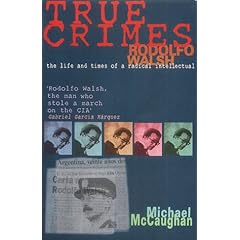
I've been reading a biography of Rodolfo Walsh (True Crimes: Rodolfo Walsh and the Role of the Intellectual in Latin American Politics by Michael McCaughan, Latin American Bureau 2000) which is also an anthology of his fiction and journalism translated into English. Not only has it been an interesting read, but it also has some eerily appropriate parallel themes with my current ponderings. Walsh was an Argentine writer and journalist, born of Irish ancestry and raised in a Catholic boarding school, wrote a In Cold Blood-like non-fiction work called Operacion Masacre, went to Cuba shortly after the Castro revolution in order to work in the news industry there and weirdly enough ended up intercepting a code from the CIA that gave away the location for the Bay of Pigs invasion, abandoned fiction to devote himself full-time to journalism and underground resistance work in the 70's once the political situation in Argentina really went down the drain, and was shot and killed in a shoot-out by the military in the middle of the street (his body was never recovered). He is counted as one of Argentina's 30,000 “disappeared” of that period. Isn't that weird, how you can sum someone's life up like that, in a couple of greatest-hits sentences? (I inevitably wonder what my own sentences will consist of...)
I haven't finished the book yet (I'm at the part where he gets really intensely involved in underground resistance), but there have definitely been some moments in the book that have given me pause and thus merit some reflection here. The short stories are excellent, particularly "Footnote" and "Esa mujer" (check them out). There's a lot of discussion in the book (as indicated by the subtitle) about Walsh's struggle with the role of the intellectual in society, which I found personally quite relevant... I feel uncomfortable about calling myself an “intellectual,” but I definitely read a lot, and like thinking about things that probably a lot of people would consider quite silly, such as “what is the role of the intellectual in society?” (After Barry-O's election and Georgie's reign, this question has been given a bit more attention.) I went to an expensive college, my parents are well-educated. I like reading fiction, writing fiction (goes without saying I need to do this one more), writing and talking about fiction. Yeah... I am pretty much a bourgeois intellectual.
I guess I struggle a lot with how relevant all of this is (the reading and writing and talking about fiction). I like doing a lot of other stuff to, outside of this—I like working with people, I like being with people, I like doing things that feel like they make more of a difference in a day-to-day sense. My job isn't super prestigious or super high paying or anything like that, but someone's got to hang out with these kids and give them something positive in their lives, you know? I dunno, I'll just say that I find it relevant and then leave it at that. My struggle (which I was reminded of again and again in this book) is finding a balance between these two things: the whole isolated hermetic ivory tower writer and intellectual tradition versus the nitty-gritty, down and dirty, involved in the world role. Is there a way to combine the two? Does it really come down to choosing one or the other? Is the role of books in my life destined to be restricted to a hobby, a sideline entertainment, or will it become a career? (The latter's up to me to decide, I guess.) Interestingly enough, in some of the interviews with family members and friends, a lot of them express frustration about Walsh's choice of journalism over politics... there's a certain attitude in their words of "oh, he could have been one of the greatest Argentinean fiction writers, he had so much potential, but then he went ahead and got involved in politics and justice." I don't think there's really a right or wrong choice; it's just a matter of the type of person you are... some of us are content, others of us are a little more scattered and need to explore different roles and careers in order to find that kind of satisfied fulfillment...
I folded over the upper-right corner on the page where Walsh is having a conversation with another young aspiring author, in his early 20's (this really hits home in terms of the theme of this blog):
“These are different times, Nicolas, and this is a time for a bigger undertaking. When you're trying to change important things, then you realize that a short story, a novel, aren't worth it and won't satisfy you. Beautiful bourgeois art! They taught us that it was the supreme spiritual value. But when you have people who gave their lives, and continue to, literature is no longer your loyal and sweet lover—it's a cheap whore. There are times when ... every spectator is a coward or a traitor. This might be a pain for the more intimate questions of the soul but that's the time we're living in.” (218)

You see this same question in a lot of Roberto Bolaño works. I just read La estrella distante (Distant Star), a 140-page novella that makes for a quick and thought-provoking one-day read. This book talks more about writers and poets than anything else, specifically one poet, Alberto Ruiz-Tagle, who gets involved with the Pinochet Regine by writing state-approved poetry in the sky. If you like Bolaño, you should definitely read this work. I never realized how influenced by Borges he was, either. I'm starting to see this as a common denominator in a lot of the stuff I've been reading or re-reading lately (Lolita, The Island of the Day Before). I don't want to give too much away about the book (part of its impact is being shocked by its unexpected development), but the novel deals with the same question discussed in the Walsh biography: what is the relationship between literature and real events? Is turning to literature when unimaginably violent events are taking place in your immediate world brave or just blind and stupid? The insightful New York Times book review of Bolaño's The Savage Detectives makes an important point:
What can it mean, he asks us and himself, in his dark, extraordinary, stinging novella "By Night in Chile," that the intellectual elite can write poetry, paint and discuss the finer points of avant-garde theater as the junta tortures people in basements? The word has no national loyalty, no fundamental political bent; it's a genie that can be summoned by any would-be master. Part of Bolaño's genius is to ask, via ironies so sharp you can cut your hands on his pages, if we perhaps find a too-easy comfort in art, if we use it as anesthetic, excuse and hide-out in a world that is very busy doing very real things to very real human beings. Is it courageous to read Plato during a military coup or is it something else?
Yeah... I'm just trying to figure stuff out, I guess. I am in a certain position of power and privilege, in the sense that I have choices of what to do with my life. And just like in Spiderman, "with great power comes great responsibility." So I am trying to figure what I want to do with my brain, and how I can find something to do with my brain that feels both worthwhile and valuable. So it goes.
.jpg)

Maybe getting glasses is the common denominator behind figuring everything out.
Subscribe to:
Posts (Atom)
