Showing posts with label truth. Show all posts

Monday, September 7, 2009

Attempts on Her Life: Truth and Self in "Portrait of a Lady"

Well obviously the apartment would be beautifully furnished. Obviously it would have high ceilings and tall windows and date in all probability from the end of the nineteenth century when the rise in speculative building coincided with the aspirations of the liberal bourgeoisie to create monumental architectural schemes such as I'm thinking particularly now I'm thinking of the Viennese Ringstrasse which made such an impression on the young Adolf Hitler as he stood one morning before the Opera.
--Or one of the great Parisian boulevards.
--Or one of the great, exactly, Parisian boulevards.

--from Martin Crimp's Complete Plays: Volume 2, page 209-212, “Attempts on her Life.”


I read this play while staying in my friend's apartment in a suburb in Paris. The other book I was reading at the time was Henry James' The Portrait of a Lady, another attempt of sorts on a lady's life. It felt highly appropriate to be reading Henry James during a two-week poor man's jaunt through England and Paris. The boulevards were definitely good representations of "the aspirations of the liberal bourgeoisie to create monumental architectural schemes;" "total Illuminati," Corey mused while contemplating them. They made me think of imperial imagery and the cult of the Roman Emperor, like we learned in my freshman year humanities class, in which dead emperors were made into gods and his cult was spread through coinage, architecture and fashion. There seems to be a lot of dangerous implications when you try to definine something absolutely.

This is the first Henry James novel I've ever read, other than his short stories in college and The Turn of the Screw in high school for AP English. I read David Lodge's novel Author, Author, an Amadeus-like story of James' failure at the theatre and his friendship with an author who was super famous at the time, but whom nobody remembers now (have *you* read George du Maurier?). His books always lined my mom's bookshelves at home, nestled in between Dickens and Vanity Fair. "Henry James is so subtle," my mom once told me (I don't know in what context, maybe we'd just finished watching Wings of the Dove or something). "You'll read a whole page, and then look up, and be like, I know that something really, really important just took place... butwhat?" That's as good of a summary of Henry James' style as I've ever heard. I mean, it says a lot that the key scene in this novel consists of Isabel sitting motionless in a chair (how did they turn this into a movie, again?).

Despite this initial fear that this novel was going to leave me feeling like I was an absolute idiot, in the end I was surprised at how much I enjoyed reading this novel. Maybe my brain has just gotten really big over the past year (ha, ha, ha!) but I honestly didn't find it that hard (I can haas literary smarts?). I definitely didn't have the same reaction as my housemate, who read the first page of Wings of the Dove and threw it across the room shouting "WHAT THE BLEEP?!" (Oh, biology majors.) I got really into the characters in Portrait of a Lady; I finished each chapter with a feeling of eager anticipation, like I was waiting for the next episode of a TV series. I would update the ever indifferent Corey on their conversations and decisions: "Oh oh, it looks like Isabel is going to accept Gilbert Osmond's marriage proposal. It's all downhill from here." "Henrietta the journalist really represents modern America! While Caspar Goodwood is a total embodiment of penetrative capitalism!"

This was an interesting book to read while traveling as a tourist. Isabel wanders through London, Paris, Rome, Florence, Venice, looking at old ruins and art, attempting to "collect" experiences like those little barbed seeds that cling to your clothes when you pass through a tall field. (Collecting is a big motif in this novel; much is made of Gilbert Osmond's art collection and his desire to keep Isabel and his daughter shut up in his nasty claustrophobic old house like expensive portraits.) There's a lot of annoying stupid rich Americans and Brits in this novel, traveling for no point or purpose, living off their inheiritances. Isabel is smart enough to see through the emptiness, commenting with typical astuteness that "doing all the vain things one likes is often very tiresome." (309) Why yes Isabel, it is very tiresome indeeed! She goes on to ponder:
The desire for unlimited expansion had been succeeded in her soul by the sense that life was vacant without some private duty that might gather one's energies to a point. She had told Ralph she had 'seen life' in a year or two and that she was already tired, not of the act of living, but that of observing. What had become of all her ardours, her aspirations, her theories, her high estimate of her independence and her incipient conviction that she should never marry?
This is my favorite quality of Isabel's: her introspection, her ability to ask those kinds of questions. When asked by the odious Madame Merle to define her idea of success, Isabel's response is "to see some dream of one's youth come true." (206) I like how Isabel philosophizes and reflects on her actions, and I'm sure it's this quality of hers that has captivated readers and literary critics for over a hundred years now.

Another thing I want to mention is the exchange Isabel has with Madame Merle in one particular section, as it sets up two different concepts of the ever popular topic in modernism, the Question of the Self. As Madame Merle puts it:
"When you've lived as long as I you'll see that every human being has his shell and that you must take the shell into account. By the shell I mean the whole envelope of circumstances. There's no such thing as an isolated man or woman; we're all each of us made up of some cluster of appurtenances. What shall we call our 'self'? Were does it begin? where does it end? It overflows into everything that belongs to us--and then it flows back again... One's self--for other people--is one's expression of one's self; and one's house, one's furniture, one's garment, the books one reads, the company one keeps--these things are all expressive." (207)
In contrast, Isabel replies, "I don't know whether I succeed in expressing myself, but I know that nothing else expresses me." (208) And thus we have two opposite viewpoints of how the self is constructed that are set up very intriguingly. A footnote from this page helpfully quotes a passage from Henry James' brother William, the famous psychologist, who writes that "properly speaking, a man has as many social selves as there are individuals who recognize him." Whoa! How do you express yourself truely, if there are so many "selfs" for you to express? Are you doomed to forever be divided into American Doll Possee fragments, or will you ever add up to a complete and wholly integrated person? And, more intriguingly, what does this imply about the problem of understanding--not just understanding yourself or other people, but understanding and interpreting ART (which can be understood as the expression of a self). AAAAAAAAAA! Now do you see why this novel isn't the typical Victorian-Realist marriage plot?!

Because this novel is so INTENSELY focused on the thoughts and meditations of the main female character (The Portrait of a Lady is an extremely appropriate title), I think the whole novel can be understood as an attempt to deal with the problem of the self: how to form it, understand it, and then communicate that self effectively with others. There's a lot of discussion about the importance of experience in this book, and I think that relates back to this idea of how do you go about constituting the self, which I see as Isabel's main struggle throughout the book. I remember reading in Derrida's The Truth of Painting, way back in junior the year, something about how the frame of a painting doesn't just close off the artwork, but also opens it up, because we're forced to view the artowrk in whatever context in which it's been presented, which in turn prevents our understanding of the artwork from ever being complete. I don't know if I'm remembering this correctly, but the basic gist is that the supposedly firm lines that "close" a portrait are ultimately misleading. This is what makes Gilbert Osmond such a creepazoid, he tries to define and trap Isabel in this aesthetic wifey little role (it goes deeper than that--doesn't it always in Henry James?--but again, that's the gist of it).

The last thing I want to touch base on is how Henry James is definitely not the author you'd read if you wanted to get an idea of how most people (that is, the working class as opposed to the rich and upper middle) were living--the coal miners, the tramps, the dishwashers, George Orwell's peeps, basically. Henry James' characters are such spoiled brats--I mean, these people really don't do anything. They just travel around Europe, looking at old ruins and collect art, in an attempt to--what? Better themselves? Improve their souls? One of the commendable aspects of Portrait of a Lady is that there are characters like Isabel and her dying cousin Ralph who actually ask themselves the essential question of what is the freaking point.

But typing up this blog entry has been a bit of a surreal experience, because I'm also simultaneously Skype chatting with someone from the microfinance office where I'll be interning this fall (yay multitasking!), in an attempt to sort out my living situation there (it looks like I'll be staying with the family of someone who works in the office, which is super bien). In the Egyptian section of the British Museum, there was this little information card talking about the lives of the farmers and workers who worked on the land and were sometimes employed on state construction projects (if my computer wasn't retarded, I'd upload the photo). To quote from the plaque: "They were not wealthy enough to be buried in decorated tombs. They were illiterate, and so their names and experiences are almost entirely lost, as in many societies. The study of human remains in poor cementeries is the only way of learning of the short lives of most ancient Egyptians."

It's weird to me, reading these Victorian novels of marriage and intrigue and travel through Europe, and think about all the short, illiterate lives that are being ignored, that have been lost to time. I think it's incredibly stupid and ignorant to criticize books for what they're not about, and that's definitely not what I'm doing. I just wanted to comment that it was just an interesting experience, to wander through these boulevards in Paris built by kings and dictators, to go home to my friend's apartment and read about characters doing the same thing, and now, I'm trying to sort out an internship where I'll be working with people whose lives definitely do not revolve around questions like "should I go to the British Museum today or the National Gallery?", or, "how is an art work simultaneously 'closed' by the artist for a deliberate aesthetic effect, yet opened up to interpretation by the audience?", or, "when we say we 'like' a painting, or a book, what does that mean? Does it mean that there was a certain 'truth' shining through the painting or the words on the page that somehow got through to us? And if so, how? How do you reveal the truth of a work of art, if the artwork itself is concerned with showing how it is difficult and even dangerous to try to limit things to a single mesage or meaning?" And so on and so forth. Yeah.

To close, here is another portrait of a lady, from the website I'll soon be working for.

Are you looking at her? Or is she looking at you?

Sunday, July 26, 2009

Rayuela, Part I

It's so hot in Portland right now there's little else I want to do other than sit in front of the fan and eat popsicles from the little Mexican tiendita. Corey and I will probably swallow our hypochondria and go swimming in the public pool down the street later this afternoon.

In a way, I guess it's good that this feels like an exceptionally hot summer in Portland (according to Corey and other long-time PDX dwellers; this is only the second summer I've spent in Portland). Last week I learned that for my internship in the fall with Kiva, I'll be interning with Fundación para la Vivienda Progresiva (FVP), in Nuevo Laredo, Mexico. So it looks like I'm heading back to the U.S.-Mexican border after all... interesting how these things work out. I'm going to have to make myself some cut-offs and buy some more wife-beaters to prepare for life in the desert.

I like how my life's narrative is increasingly becoming defined by the quest for the random and marginal... I'm not exactly sure how all these experiences I'm seeking are supposed to add up to make a coherent, cohesive whole, but then again I'm not sure if I want it to.


This quest for the weird and marginal feels particularly relevant to me, maybe due to the current Big Book I'm reading, Julio Cortázar's Rayuela (or Hopscotch). My sister read this book way back in the day in high school, and then read it again three years ago in Spain. She told me that although she enjoyed it when she read it the first time and knew with certainty that it was a great book, she didn't "get it." As I read it for myself now, I can easily see how there's a lot of stuff here that would make a nice big whooshing sound as it flew over a ninth-grader's head (like what happenned to me and Lolita when I read it in eighth grade and totally didn't "get" the beautiful, erotic love story). I've been reading it in Spanish, and while it's been slow going, almost frustratingly so at times, it's been much more rewarding than reading it in English.

The most exciting aspect of this book is its similarity to the Choose Your Own Adventure series. As the little note by the author on the first page informs us, there are two different ways of reading the novel. In Reading #1, you can read it straight through to Chapter 56, “at the close of which are three garish little stars which stand for the words The End.” (All excerpts from the novel in English are taken from Gregory Rabassa's 1986 translation.) In Reading #2, you begin with Chapter 73 and then hop around the chapters (including Chapters 57-155, described as “expendable), based on the little number printed at the end of each chapter. If you confront the list at the beginning, the one that lists the order in which you'll read all the chapters for Reading #2, you'll discover that you'll eventually be suspended in an infinite loop, hopping back and forth between Chapter 58 and Chapter 131. I'm only on Chapter 37, ending Park One (Del lado de alla/“From the Other Side”) and beginning Part Two (Del lado de aca/“From This Side”), but I'm interested in seeing where I'm going to end up inevitably suspended. It's all really quite ingenious.

Other competitors for the Trippy WTF literary devices category include chapter 28, which skips from page 162 to page 179, without explanation. As this is the chapter when an important character is found dead, I'm assuming these missing pages have something to do with this. To make things even weirder, in the English translation I have checked out for reference, these pages are included. I haven't read them for fear of “spoiling” something that will later be revealed to me as the book progresses, but still, how strange! Where did these pages come from? Are they still waiting for me somewhere, lurking in the back of the pages I have yet to read? Where on earth did the English translator get them from? What a weird situation. At least it highlights the dramatic contrasts that can be found between reading a book in the original language versus the translation (the other translation problem I have with is the translation of “papas fritas” as “fried potatoes”--wouldn't this be French fries? What do you call “fried potatoes” in France?).

Chapter 34 is also an excellent candidate for one of the weirdest reading experiences of my life. So that you can try it out for yourself, here's an excerpt:

"IN September of 1880, a few months after the demise of my
AND the things she reads, a clumsy novel, in a cheap edition
father, I decided to give up my business activities, transferring
besides, but you wonder how she can get interested in things
them to another house in Jerez whose standing was as solvent
like this. To think that she's spent hours on end reading tasteless
as that of my own; I liquidated all the credits I could, rent out
stuff like this and plenty of other incredible things, Elle and
the properties, transferred my holdings and inventories, and
France Soir, those sad magazines Babs lends her. And moved to
moved to Madrid to take up residence there. My uncle (in truth
Madrid to take up residence there, I can see how after you swal-
my father's first cousin), Don Rafael Bueno de Guzman y Ataide,
low four or five pages you get in the groove and can't stop read-"


(Rabassa 191) If you figured out that you're supposed to read this by skipping every other line, then you're a lot smarter than me (to be fair I was reading it in Spanish, and I kept plunging gamely on with the hope that this was some kind of avant-garde rap and that it would begin to make sense to me eventually. The broken-up words like “swal-” and “read-” were what eventually gave it away). How clever, no? As you go on reading this chapter, you realize that the odd lines are from one of the trashy novels that Magda loves to read, and the even lines are Horacio's interior monologue as he reads the very same lines that you've just read, criticizing the book as he reads it (like with the Madrid sentence in the passage above). How clever, no? I don't know if I've ever come across a better attempt to reproduce the experience of reading, by means of spatial arrangement right there on the page. On the last page the lines from the trashy novel drop off and you're left with Horacio, imagining himself and Magda wandering around the city but never meeting, “two points lost in Paris that go from here to there, from there to here, drawing their picture, putting on a dance for nobody, not even for themselves, an interminable pattern without any meaning.” (197) There you have Part 1 of Rayuela in a nutshell: aimless wanderings, a quest for a missing center, the lack of meaning, the concern with geometry.

This is a good book to be reading following the graduation of college. There's a lot of sitting around and Bolano-esque talking, smoking cigarettes, drinking, wandering through the streets of Paris and the eating of fried eggs and potatoes (I love it when authors inform us of what their characters like to eat; Bolano and Murakami are masters of this). There's a lot in the book about wandering around without any direction. The main narrator so far is Horacio Oliveira, an Argentinian writer who lives in Paris with his Uruguayan girlfriend, La Maga. He spends a lot of time either walking around Paris with la Maga, hanging out with his group of bohemian friends who call themselves “El Club,” and having weird and random adventures, like in Chapter 23 when he attends a concert by an eccentric modernist pianist. Part 1 ends with a death, Maga's disappearance, and Horacio's Dante-like descent into degradation and sordidness, which ends with him getting deported back to Argentina. We'll see what Part 2 has in store for him.

Horacio is definitely looking for something. As la Maga tells him, “I think I understand you... You're looking for something you don't know. I've been doing the same thing and I don't know what it is either. But they're two different things.” (76) I like the part when Horacio ponders that “this mate might show me where the center is.” (78) There's this the very Borges-esque thread running throughout the novel, the Argentinean preoccupation with the search for an absent center, the desire to come back to an origin, the desire to understand, the desire for meaning. Ironically enough, while searching for these very structured concepts, Horacio also stubbornly rejects “the idea of unity [which] was worrying to him because it seemed so easy to fall into the worst traps.” (79) Much is made of Maga's lack of intellectualism, but as Oliviera observes, while he imposes “the false order that hides chaos, pretending that I was dedicated to a profound existence while all the time it was one that barely dipped it toes into the terrible waters. There are metaphysical rivers, she swims in them ... I describe and define and desire those rivers, but she swims in them. I look for them, find them, observe them from the bridge, but she swims in them. And she doesn't know it.” (95) There's a lot to unpack there, but suffice it to say, it sure does sound pretty. There's also a lot of Buddhist-related meditations on death and connectedness and the importance of the present moment, which surprised me.

There's lots more I could say about this, but I think I'll leave it at that, mainly it's currently the hottest part of the day and it looks like we'll be going swimming after all. Time to return to the present moment.

“My hand pokes around the bookcase... I take down Roberto Arlt... Today fascinates me, but always from the point of view of yesterday (did I say phascinate?), and that's how at my age the past becomes present and the present is a strange and confused future where boys in baggy sweaters and long-haired girls drink their cafes-cremes and pet each other with the slow gracefulness of cats or plants.
We must fight against this.
We must establish ourselves in the present once more
.” (94)

Sunday, June 21, 2009

2666: no angel came


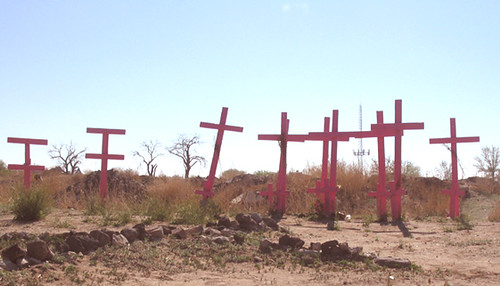
I went to Juarez spring break of 2005. I was a college freshman and the main preocupation of the trip was worrying about whether my Spanish would be accent-free enough to impress the Mexicans, and how much attention my ex-boyfriend (who also came along) would give me. Typical mindframe of the self-absorbed spoiled 19-year-old (I'm being hard on myself, but lah dee dah!). There are a couple of things I remember about the trip. I remember feeling completely terrified as we walked over the border from El Paso into Juarez; I was convinced that as a large group of white kids, we were going to be mugged immediately just walking down the streets (we weren't). I was impressed by how the people for the labor union we interviewed smoked inside their offices. One of them invited us to stay back at their house for the night and I remember being shocked that it was made of mud and tin--I guess I thought that since she wore nice clothes and worked in an office, the house would be nicer. It was very touching. I remember the anarchists whose house we slept in one night and how in awe I was of them. All in all, I think I was too young and inexperienced to absorb or analyze the experience properly. It was experiences like that that make me really believe in the validity of experiential learning: you really gotta get out of your self-absorbed head and experience education for yourself, first-hand. Your early experiences where you're kind of dumb and in over your head are like bricks that you're stacking for experiences later on in life, where hopefully your eyes and ears are a little more open.


In the same way that Che Guevara ate my May, Bolaño has completely swallowed my June. Maybe that's why this entire month has felt so weird and unbalanced to me: how can you expect to be in a sort of stable mind, when you're reading page after page of descriptions of horribly mutilated bodies of women found in the desert? Then you gotta put the book away, get off the Max and then hang out playing with kids for 6-8 hours. Talk about disjointed!

Unsurprisingly enough, there's a lot to be said about this almost 900-pg monster. I'm not even sure where to begin. I kind of feel the way I imagine I would feel after finishing "Ulysses" or "Moby Dick": simultaneously drained and exhilarated. I borrowed the book from a friend, so I couldn't underline any passages or fold the corners of the pages over when I read an excellent quote or a passage that felt particularly meaningful, so that makes me sad, because now, faced with the prospect of this "review", I have this 893-beast in front of me, and I have even less idea of where to begin than I would otherwise. So in advance, let me proclaim I am definitely going to have to re-read this, and thus analysis is definitely going to be very sketchy and first-impressiony, at best.

This book is very different from a lot of Bolaño I've read before--"epic" is definitely the first term that comes to mind. While other Bolaño books felt like the novels that Borges would have written (had he ever written one) "2666" is unmistakably and clearly Bolaño; there's no mistaking his style for another author's. What do I mean by Bolaño's style? I guess when I think of Bolaño, I thinkof the Murakami-like flourishes of what the characters ate or drank for dinner. The plotless plots where nothing really happens and nothing gets explained or resolved. His morbid gloomy view of life contrasted with the fierce joy his characters feel for reading and writing (a characteristic strongly reminiscent of Arlt's "El juguete rabioso" hero). That is Bolaño for me: witty, gloomy, harsh social realism, subtle political commentary, passionate crusader for the validity and worthiness of writing endeavors.

The book is divided into five parts, which all have titles like "The Part about the Crimes" (which unfortunately reminded me of the way "Friends" episodes are titled--the similarity ends there, thankfully!). The first book is the one most similar to the Bolaño I've read before: four literary critics, in the style of "The Savage Detectives", travel to the Mexican-U.S. border town of Santa Teresa (a fictionalized version of Juarez that easily deserves to be mentioned in the same breath of Macondo and Santa Maria) to track down an obscure German author, who may or may not have been last seen there. "I know the two of you will understand," is the last sentence in book one, but we don't.

Out of the five books, the fourth (the one documenting all the murders) is ironically both the most gripping and the most difficult to read. I feel sick about myself typing this, but it gets almost boring, turning the pages: oh, another murder, another death by strangulation, another unidentified decomposed body in the desert, another closed case, another police investigation that goes nowhere... I rached a point where I just felt numb reading name after name after name. The deaths quickly come to seem depressingly similar. Anally and vaginally raped. Body unclaimed and unidentified. Maquiladora worker. Eleven, twelve, thirteen, fifteen, sixteen, seventeen, twenty, thirty-three years old. Bolaño isn't stupid, so this numbing effect is obviously what he was going for. What Bolaño does with thepolice detective genre is very intriguing, as he writes in this very matter-of-fact, CSI-documentation tone. The following quote is a pretty good example of most of the descriptions of the deaths:

In the middle of November the body of another dead woman was discovered in the Podesta ravine. She had multiple fractures of the skull, with loss of brain matter. Some marks on the body indicated that she had put up a struggle. She was found with her pants down around her knees, by which it was assumed that she'd been raped, although after a vaginal swab was taken this hypothesis was discarded. Five days later the dead woman was identified. She was Luisa Cardona Pardo, thirty-four, from the state of Sinaloa, where she had worked as a prostitute from the age of seventeen. She had been living in Santa Teresa for four years and she was employed at the EMSA maquiladora.

And so on and so forth in the longest chapter of the book. Anyway, so it's interesting that Bolaño uses this detective tone to describe this very physical, material evidence in the form of mutilated bodies, and yet despite all their materiality, this bodies embody absence more than anything else: there's no explanation for how they got there, no solution for the crime, and no resolution. Meaning is ecliped and absent despite this very matter-of-fact, supposedly transparent prose. Again: talk about disjointed.

This treatment of meaning (or as my blogspot tag puts it, "the form of truth") by Bolaño is something that definitely deserves a lot more thought (and not just because of his professed admiration for Borges, who loved writing his way out of stories without centres). For a lot of modernist authors (like Kafka and Conrad and so on), meaning was still around recently enough for them to still be pretty bummed about it draining away. That's why so much of modernist fiction seems to centered around the absence of meaning, something empty and silent and critical: hence the empty caves in E.M. Forster's India, Joseph K's crime, Virginia Woolf's lighthouse, Onetti's goat, Godot, Addie's monologue. There's definitely still traces of that critical silence and absence here in Bolaño. One of the questions I have is whether or not Bolaño he sees this absence of meaning as something to be all angsty and anguished about, or whether he sees literature and fiction as sufficent compensation for the disorder and meaninglessness of the world.

On that note, I think one of the most important things to mention when discussing what makes something "Bolaño-esque" is his use of absurdity. In the face of some things that could just never make any coherent sense (like why someone would shove a metal pole up at 12-year-old girl or bite a woman's nipple off and dump her body in the desert), sometimes absurdity is the best (and perhaps only) option. By absurdity, I mean all the extraneous details that go on for pages and pages: what characters dreamt last night, and all the random people who pop in for one scene of the novel and just as quickly pop out, never to be seen again (WTF is up with the psychic lady on TV? The Indian carpet-vendor girl one of the literary critics falls in love with? I could go on and on).

Another thing to consider when trying to define the Bolaño-esque is this quote by the one and only Eric Blair: "a novelist who simply disregards the major public events of the moment is generally either a footler or a plain idiot." With his use of Santa Teresaa as his stand-in setting for Juarez, Bolaño is definitely making very powerful political commentary about violence and power. I see violence as one of the main themes in this book: this dark beast that we have in all of us, which we need to get in touch with in healthy ways (a la Pip from American Doll Posse), but when we let it take control of us--yikes. Even the first book, the one about the literary critics, has this very interesting passage where they randomly beat the shit out of this Pakistani taxi driver. No one escapes, it seems, irregardless of your literary and academic pretentions.

The second book ("The Part About Amalfitano") is a character study of a university professor who may or may not be going crazy. It felt like the most random of the five parts to me. The image at the center of the second book involves a geometry book being hung out on a laundry line, slowly getting eroded by the elements as the professor waits to see how long it takes for the desert to destroy literature (this feels like a very important metaphor for the rest of the novel to me: how does literature stand up to the eroding, corrosive effects of the really harsh, fucked up reality that is our everday lives?).


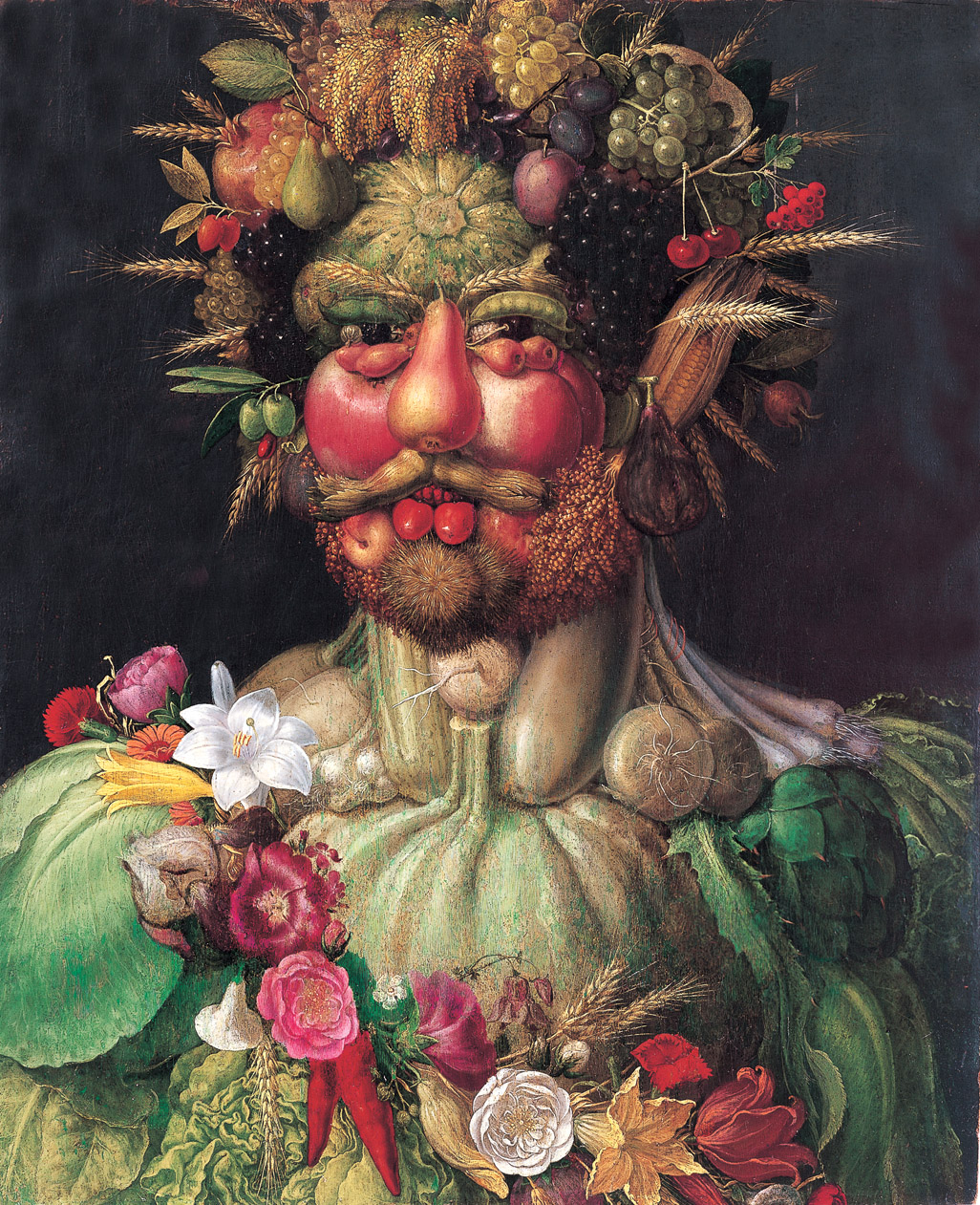
The fifth book is the the one about the German author, Archimboldi, whose name is apparently a homage to the the painter Archimboldo, whose work is depicted in the picture above--his paintings are of individual subjects that together form an apparent whole, just like how the five Parts in 2666 are meant to form one entire work. This book is the most surreal and dream-like. What to make of the last 3 pages? Why does this book end with a guy in a park talking about the different ice cream flavors his ancestor? Is it a commentary on the impermenance of art? The randomnee of life? A homage to Cesar Air and his fondness for strawberry ice cream in How I Became A Nun? Man, I don't know! Good God, give me a place in a PhD program and maybe I'll give it my darndest to figure it out!

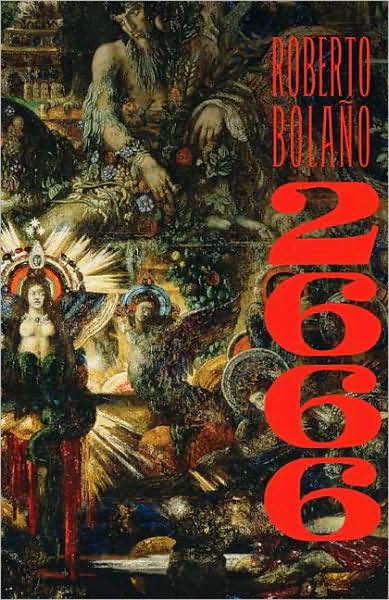
"Apocalyptic" is another word that comes to mind for this book. When one of my co-workers saw the cover, he asked me if it was a book about the devil. "It doesn't seem to be yet," I answered honestly. I haven't even touched upon all the apocalyptic imagery and references to the Four Horsemen and the reoccurring images of the abyss and voids that keep coming up, again and again (as the review in Slate handily pointed out). Mental institutions and jails also appear in each of the five books, so I think that's probably important as well. There's also a lot of scenes that play with light and dark: on the last page, "Suddenly the park lights came on, as if someone had tossed a black blanket over parts of Hamburg." (893) Similarly, on the last page of Book 4 (The Part about the Crimes), "Some of these streets were completely dark, like black holes, and the laughter that came from who knows where was the only sign, the only beacon that kept residents and strangers from getting lost." (633)

For Bolaño, is literature the only beacon that keeps us from getting lost? Why else would the story of writers (university professors, academics, journalists, authors) be juxtaposed with the story of these crimes? Does Bolaño think fiction can save us, or is it a petty refuge, a distraction from the savageries of realism implemented by bourgeoise folks like the Jesuit priest in By By Night in Chile in order to distract us from the torture going on beneath the floorboards of our houses? In By Night in Chile and Distant Star, the violence always took place "off-screen." In contrast, the violence in 2666 is very front and center. I think that's why Germany plays an important role in the fifth and final book: if you want to write a book about torture and mass crimes and the apocalyptic end of eras, then yeah, WWII Germany is about as good of a setting as it gets. "The bones, the cross, the bones," is all one character can say in face of it all, and that's about as close to the the expression "the horror! the horror!" that Bolaño gets.

A lot of people are going to write their doctoral dissertations about this book in the next 5-10 years. This book makes me feel proud to be alive during the period in which it was written.

For further reading:
- A list of all the names of the women who have been murdered in Juarez, from 1993-2006, with a brief synopsis of death.
- Very good article from the Nation about 2666.
- The best article on Juarez I've read on the Internet, written for Salon by Max Blumenthal.
- Tori Amos' solo performance of her song "Juarez" from 1999--she looks like she's about to burst into tears at the end.

Sunday, February 15, 2009

History as the Only Refuge: "Artificial Respiration"


Man, this is one of my favorite books. I've never read anything else quite like it. It's like reading all the notes and theories and ideas from my advisor's classes condensed into a single volume of fiction (which would make sense, since Piglia was his advisor at Princeton). I read it over the summer in Spanish and have now recently re-read it in English, in a version translated the same guy who translated the Onetti versions I used for the T (why am I still talking about this thing a year later? Suddenly I understand why you get more than one year for your PhD dissertation... nine months is just not enough time, not at all).

The best way to describe Piglia's fiction is literary criticism masquerading as fiction. Or perhaps fiction masquerading as literary criticism. I can definitely see someone reading this and throwing it across the room, complaining loudly that "nothing ever happens in this book!" That is definitely true. The last 100 pages or so consist of a Polish expat espousing on his theories on the relationship between Kafka and Hitler, the theories of Wittgenstein and other such deliciously philosophical nuggets. I for one loved it, and I think whoever says that these parts of the book are irrelevant or distracting from the main storyline are missing the entire point (upon second reading, I now seriously think the Kafka-Hitler section is the key to the whole book, and not just because how the description of Kafka's death from tuberculosis in a sanatorium provides a key to the book's title).

In the introduction, Balderston cites a useful quote from Piglia on the importance of literary coding in his work:
"Piglia argues that it is a mistake to read Artificial Respiration as a simple product of a period of state terror. "I believe," he says, "that coding is the work of fiction in any context... I believe that fiction always codes and constructs hieroglyphs out of social reality. Literature is never direct... What I do believe is that political contexts define ways of reading."
Codes and attempts to decipher play an important part in this book (isn't that all what literary criticism is anyway? An attempt to "decode"?). As the Polish character says near the end of the novel, "To read, one must know how to associate." More than anything else, AR asks us to associate, to decode--to be good, active readers, which is imperative considering the subject at hand.

It's interesting that Piglia mentions the period of state terror in which AR was written, because I can definitely imagine someone (albeit someone a bit clueless and stupid) reading this book and just plain not getting the state terror angle at all, because it is never directly referred to, not at all, not once. One thing that makes this translation particularly useful to read is that Balderston includes all these endnotes explaining Piglia's references to different historical figures and events in Argentine history. You can definitely tell that Piglia was a historian by training. Balderston raises the interesting possibility that the books title refers to the Argentine Republic (Respiracionn Artificial--Republica Argentina). Is it be possible to read this entire book as a sort of retelling/narration of the history of Argentina itself? Probably yes x1000 (there's definitely enough endnotes to reinforce that argument).

Anyway, it's interesting to see that Piglia sees state terror as such an important presence in the work, and yet it is hardly mention. That deliberate silence in the novel completely changes everything, casting a giant shadow over everything that takes place, from the character that everyone waits for in the last 100+ pages who never appears, to the stand-in-for-the-reader character pouring over old letters and notes, looking for codes and hidden messages. It's like a giant Voldemort lurking on the edges of the pages, a dark He-Who-Shall-Not-Be-Named. As the Polish guy says, "To speak of the unspeakable is to put in danger to survival of language as the bearer of human truth." (213)

In reference to this silence of trying to speak of the unspeakable, the famous quote by Wittgenstein is cited several times by different characters: "What we cannot speak about we must pass over in silence." In AR, what cannot be spoken about refers to both events and knowledge. As I see it, all of AR revolves around the following question: how do you speak about the unspeakable? That's why the section that describes an imagined encounter better Kafka and Hitler is so important. Kafka is described as "the one who knows how to listen," (206) "attentive to the sickly murmurs of history," sitting at the cafe table, listening to Hitler's angry rants and passionate plans for his future domination. History = his-story. Kafka writes fiction that masquerades as coded messages from the past about the future; he speaks of the unspeakable. Piglia writes about the state terror of Argentina while not writing about it, and it doing so, he is making a lot of interesting implications about how it is possible to write about reality (the same dilemma Joyce attempted to tackle). He seems to be saying to do so is impossible, which is why he focuses so much on characters talking, on letters, on outlines and drafts for potential novels, on techniques that are the logical follow-up to Borgesian fictions. Wow, it all just kinda really blows my mind.

The last thing about this this book I want to briefly touch upon is the theme of the classical Bildungsroman. There's a lot of talk by the characters on the importance of experience in the formation of characters and lives (I think it is here where PIglia's fanboy Onetti homage is most evident). Let me share with you some of my favorites:
"Sooner or later, I thought, I am going to become a great writer, but in the meantime I should have adventures. And I thought that everything that happened to me, no matter how idiotic, was a way of accumulating that depth of experience on which I assummed great writers built their work... what can one have in life but two or three experiences? All of us invent a variety of stories (ultimately versions of the same story) so as to imagine that something has happened to us in the course of our lives: a story or series of stories that ultimately are all that we really have lived, stories we tell ourselves so as to imagine that we have had experiences or that something meaningful has happened to us. But who can guarantee that the order of the story is that of life?"
This is so related to my thesis that it makes me want to die.

Here's my other favorite quote, from the chapter narrated by the Senator, who is perhaps the most Faulknerian character in the appropriately most Faulknerian chapter:
"Sometimes, I think I understand it all.. The understanding lasts but a moment and in that moment no doubt what has happened is that I have fallen asleep when I thought I was thinking or understanding... how could I expalin that? How would I--how could I--do that? That's why I must stop talking now I, the Senator, should, for a moment, stop talking. What I cannot explain without words I prefer to keep silent," said the Senator, "as I am unable to explain without words."
This quote sounds a lot better in Spanish; it reads a little clunky it English, which is unfortunate.

I have six more pages of handwritten notes about AR, but I think it's best that I stop here. It's books like these that make me glad I'm alive.

Wednesday, April 9, 2008

Faces of Life and Death

“In the course of the nineteenth-century bourgeois society has, by means of hygienic and social, private and public institutions, realized a secondary effect which may have been its subconscious main purpose: to make it possible for people to avoid the sight of the dying. Dying was once a public process in the life of the individual and a most exemplary one… In the course of modern times dying has been pushed further and further out of the perceptual world of the living… Today people live in rooms that have never been touched by death, dry dwellers of eternity, and when their end approaches they are stowed away in a sanatoria or hospitals by their heirs.” (Benjamin)

I'm afraid of death. I don't think my brain can fully comprehend it. I have never had to fully confront or face it. There are people close to me who've had people close to them die. My grandfather died a few years ago and I saw the profound affect it had on my mother. The closest I've been to death, I guess, is when my nanny died of a heart attack at a bus station. It still upsets me to this day, thinking about that.

There seem to be two ways of understanding death: death as the simple end of life, in a biological return to nature; and death as a disappearance that is also a step towards of gaining something new. This latter concept of death can be seen in Christianity and many other religions, where the idea of death is seen as a step towards ‘direct contact’ with the truth, or death as a means to achieve a closer approximation to truth.

Even if we may not think about death every day, our whole existence is marked and characterized by our relation to death. This connection with death, therefore, determines the existence and the essence of knowledge. If we do not make sense of the time that is given to us as one limited by our own death, if we assume that we're immortal and that our actions have no meaning, then we are existing in a meaningless coming and going of day after day, where our life cannot form itself into one whole and meaningful existence.

According to Hegel (ooh, philsophy so exciting!) human beings are defined by their ability to make choices; it's what differs them from stones. ‘Being’ vs. ‘being able to’. Our choices for action always have something to do with knowledge. To choose to take action thus calls for an examination of your knowledge of your own life. And yet, I can never look at my life as a whole, since it has not yet come to an end, and is therefore still incomplete.

Therefore one can only ‘know’ the meaning of one’s life after death. It is a knowledge that remains completely unavailable and unattainable to me throughout my lifetime, since when it does become available, I will be dead. My life as a whole and its meaning will exist in the eyes of those that survive me. Only they will be able to judge whether my life has been truly worth living or not. Consequently, as long as I am alive, I cannot know myself, and when I am dead, I will not know myself either. Bummer. Instead, we have to settle for understanding our life from the viewpoint of others, and it is for this reason that we understand death as well as something that happens to others, which is to say to ‘everybody else, but not me.’ It is for this reason that we become habituated to mistake death for an abstract fact of life, rather than a concrete part of our existence. How often do you really think to yourself, "I could be dead right now. What if?"

In regards to using knowledge in order make choices which eventually lead to action: how does my life become something that I choose, rather than something that others choose for me? How do I live an authentic, individual life (and thus die an authentic, rather than mechanical, death?)? The whole of my life is still not a given; its meaning stretches out before me like an empty meadow. The way that this meadow will be filled is only in my control up to a certain point, because I have no way of knowing when and where and how I will die. Such thoughts brings all of us anguish and insecurity in us all (not just Woody Allen), the basic concept of not knowing what the future has in store. Ironically enough, only thing that any of us can know as a 100% given in our future, out of all the different possibilities and paths our lives may take, is that we will die. It sounds self-evident and kind of "duh" to say so… but in order to exist authentically, I must understand first that I am a temporal being. Easy say--hard do!! The meaning of my existence cannot be granted in terms of looking at it in terms of minutes, seconds, days, or years, but rather that the ‘meaning of my life’ can only be understood as a whole, as a concrete temporal span, as opposed to a series of moments.

If it were not for the presence of death, we would remain in the illusion that things could go on as they are and therefore we would not have to do anything about our lives. It is our knowledge of our deaths, then, that makes us make the choices to act. Death, while limiting the possibilities of what I can do with my life, is also simultaneously the source of all the possibilities of what I may or may not do with my life. It's a negative that is also a positive. Moreover, it is only in death that I am truly unique. In everything else that I am, I can be substituted by another—Reed student, Corey’s girlfriend, etc. (not for biological sister though...hmm).

Where does this leave me? I've never been able to live according to the creed "Live each day as though it were your last." Obviously if we all really lived by that creed, people would be rolling around in fields and jumping into oceans as opposed to going to class or work, I think the sentiment behind that expression is more in terms of "Make the most of your time each day, because it's limited; be constantly asking yourself, 'is my behavior right now truly getting me what I want?'"

I remember at my nanny's funeral, somebody in her family gave me the candy and hair barettes she'd been carrying in her pockets, little gifts she often got for me and my sister. I remember how my sister and I just looked at each other wordlessly: I wouldn't know how to explain in words even if I knew what it was, but we were definitely feeling the same thing. I also remember, at the wake, my mother asking me if I wanted to see the body in the coffin. I shook my 'no.' I remember feeling that very strongly, of emphatically not wanting to see the body (even typing "the body" feels strange... as though it wasn't Angela, my nanny, who was dead and in the coffin, but rather "it", the body, something separate, something different, a horrible mistake, a mix-up of the universe). I guess I felt like "it" would ruin my memories of HER as alive; I didn't want them stamped out by the face of a gray corpse instead. The funny thing though, is I still try to picture and imagine what she would have looked like, anyway. That's what I kept thinking about, looking at the link in the first sentence. The way everyone's lips are droopy, the way the skin of everyone's faces seems to be close to sliding off. I feel unnerved and disoriented right now, sitting in the living room with my computer warming my lap, a lukewarm espresso at my side. I don't really know what to do next.

"The words outlive me, because in a certain sense I am irrelevant to them." (Blanchot)

Saturday, March 29, 2008

"But there's that danger in her eyes that tells such desperate lies, and all you want to do is believe her"

I'm having an incredibly hard time focusing for the final push to finish the first draft of my thesis. In some ways this is to be expected: after such a rigorous spring break, it isn't surprising that I spent most of this week feeling burnt out and exhausted. So I thought a "writing" excursion, any kind of writing, would be a good way to get my brain gears turning on the right track again.

It's lonely in the house today. My housemates are all either acting in or watching a production of "The Vagina Monologues." My sister is in the hospital, getting operated on for an erupted cyst. I know it's a fairly routine procedure and I shouldn't be using it as an excuse to be too distracted/distraught to work... and yet, here I am.

Last night Corey and I went to a Bruce Springsteen concert. BRUUUUCE! I remember hearing those calls on his live albums and wondering at first why the audience was booing. In contrast to the Justice concert we went to on Wednesday (we've had a surprisingly and undeservingly busy social-outing week, considering my FIRST DRAFT IS DUE MONDAY), we were the youngest people there, as opposed to clumped among the oldest. Our seats were behind the stage but it didn't end up mattering, as I think we got a better view than the people sitting in front, who were further away. Upon seeing the Boss arrive on stage I was surprised how he was less chunkier than I expected--I guess the camera really does add ten pounds!

I didn't really get into the concert until the band kicked into the third song, "Lonesome Day." Suddenly I was bouncing on my feet, singing along and waving my arms, as corny and cheesy as everyone around me. Every song seemed to come attached with the memory of a certain moment in my life--listening to "The Rising" album over and over again after Patrick and I broke up; "Darkness on the Edge of Town" album jogging doggedly along the dark and cold winding country roads of England; "Dancing in the Dark"--how is this song *not* about everyone's high school experience? He played three of my favorite songs, "Candy's Room", "She's the One" (the ONE song I wanted to hear live!) and "For You" (Elizabeth Wurtzel, if you could have been there!) All about damaged, elusive women, I note with interest.

Bruce Springsteen reminds me of the movies or bands you liked when you were a really young or impressionable kid, like "Return of the Jedi": you know inherently that the Ewoks are corny, that the dialogue is cheesy, but goddamn does it still get to you, the way Luke is has come into his own dressed in black and stomping around, and the way the camera pans to the night sky after Darth Vader's funeral (Old version only! Not the remastered travesty!). It gets you, and you can't explain why to anyone. I can't explain why "Candy's Room" gets me so much, or why the lyrics that serve as this entry's title seem to hold some kind of deeper and incredibly powerful, important significance to me, and even if I did, you wouldn't understand, because it wouldn't be comprehensible. It's like my thesis--God! Like everything!

Gadamer talks about this effect that art has on us in "The relevance of the beautiful"--things get us, and we can't explain why. It's unexplainable, it's ineffable, and we can't quite put our fingers on it. It is not a type of knowledge that results from positivism, objectivism, or logical thought processes, but rather a "different type of knowledge" (a phrase I am fond of frequently using in my thesis, though it desperately needs a more concrete definition!).

Gadamer gives the example of an organist improvising during a concert, a piece that was not transcribed and thus will never be heard again (I think of the bridge in "Yes Anastasia" that Tori never plays live, supposedly because it was improvised on the spot). Gadamer writes:
"Nevertheless, everyone says 'That was a brilliant interpretation or improvisation,' or on another occasion, 'That was rather dull today.' What do we mean when we say such things? Obviously we are referring back to the improvisation. Something 'stands' before us; it is like a work and not just an organist's finger exercise. Otherwise we should never pass judgment on its quality or lack of it. So it is the hermeneutic identity that establishes the unity of the work."
For Gadamer, this thing that "stands" before us that makes improvisation "art" as opposed to meaningless banging on the piano is tied to the idea of "hermeneutic identity," or the idea that we are all rooted in a tradition and history that leads to us understanding what is a work of art, and what is meaningless banging:
"To understand something, I must be able to identify it. For there was something there that I passed judgment upon and understood. I identify something as it was or as it is, and this identity alone constitutes the meaning of the work."
Is this all fairly obvious and self-explanatory? For Gadamer, meaning arises from our place in history and tradition. One of the things my thesis is arguing is that this can be authoritative and dangerous.

This biggest problem currently facing my thesis is I have yet to explain exactly what this "different type of knowledge" is. As of now I just vaguely make references to "ineffability," "dreams," and "forms." My adviser wisely advised me to avoid the word "aesthetic" because Gadamer's fond of it, and I'm arguing against (or presenting an alternative) to Gadamer. But all this is turning into putting off finishing the "A Rose For Emily" section at this point. I guess it's a good sign, though, if a review of a Bruce Springsteen concert can turn into Gadamer's discussing of the hermeneutic identity of a work.

Wednesday, March 26, 2008

refeshingly depression

I highly recommend watching this video. I almost never follow the news, let alone on Iraq. I guess lately I've been looking for distraction on my thesis, but what I have been finding instead is perspective.

There's something really cathartic about hearing these words spoken on a screen (if only my tiny glowing blue computer):
"The Americans in Iraq are like a virus, like a disease. And for us we need to get rid of the Americans, because the Americans just don`t know what they`re doing."

and
"it's a crime after five years that electricity is not back to prewar levels, because Saddam Hussein, who was a dictator I detested, was able to have electricity back in 45 days. So, why is the United States not having achieved that in five years? It's not just miscalculations. The priority was, you know, to make sure that the oil flows. Sorry, but that is true. The only sector that`s working well right now is the oil sector. It`s not the schools, not the hospitals, not the reconstruction. The oil sector is working.


What a mess. It's telling that this makes me think of my thesis, specifically the relationship between truth and fiction. I was reading excerpts from Ricardo Piglia's "Critica y Ficcion" today. He's an Argentine writer and was my advisor's advisor at Princeton, and has provided me with a good quote on the relationship between truth and fiction:
"Me interesa trabajar esa zona indeterminada donde se cruzan la ficción y la verdad. Antes que nada porque no hay un campo propio de la ficción. De hecho, todo se puede ficcionalizar. La ficción trabaja con creencia y en este sentido conduce a la ideologia, a los modelos convencionales de realidad y por supuesto también a las convenciones que hacen verdadero (o ficticio) a un texto. La realidad está tejido de ficciones."


Reality is woven out of fictions. Hmm.