Showing posts with label Cortázar. Show all posts

Sunday, August 9, 2009

the circle game

There is always something terrifying about purchasing plane tickets, in all their stark finality:
September 12th- Fly from PDX to L.A.
- Visit Cara, Laura, other California people (Ana?)
September 16th- bus to San Luis Obispo to visit my Grandma
September 20th- bus to San Francisco
September 21st-25th- Intern training in San Francisco
September 26th- Fly from L.A. to Laredo
11pm that night CROSS BORDER INTO MEXICO (either that or sleep in the airport)
December 23rd- Fly from Laredo to PDX
August and September are gonna be some crazy months. Corey and I leave for England on August 17th. We get back on September 2nd. I work for one more week, and then I leave. AAAAAAH! Change can be scary. But change is good, I think.

I've been doing this thing since April where every day I write down in a little notebook What I Did That Day. No analysis, no introspection, just bare naked facts. My drive to record things amazes me, sometimes: how much do I really need? Paper journal, livejournal, this blog, and this notebook? Anyway, it's interesting to flip backwards and see What I Did on a certain day of the month. For example, here is What I Did on the 9th:
April 9th- sick day. Sleep a lot.

May 9th- Wake up early to go to coast with Solange and Aiden [visiting friends from Paris]. Long drive to Cannon beach. Play music from ipod. Beach windy, weather beautiful. Farmer's market in morning. Gumbo for dinner delish. Catch 4 fat mice in traps.

June 9th- Wake up from nightmare of falling in black void. Corey comforts me. Alarm at 6.20 AM. Roll out of bed and catch Max. Buy sandwiches at Safeway, $33. Big sandwich makes me sick, leave it by library for homeless. Arrive at work, program planning with Allie + Jose in Learning Center. All computers broken, I greedily grab #9, the only one that works. Trip to Starbucks with Alex for a soy latte. Talk about her caffeine overdose and hospitalization.

July 9th- Wake up late, 6.20. Bagel + coffee breakfast. Write sketch of book review and start typing up story. Take kids to Shute Park, Plaid Pantry field trip to buy seeds for bird feeders. Animal presentation by Zoo people underwhelming. Take 10-12 year olds to park in afternoon, Alexis left behind, cries. Long Max journey home. Caught without ticket by Max officer, given ticket. Cry hysterically on phone with Corey, feel better. Hang out with Laura at Laughing Planet and Hotboxx as she leaves for CA the next day.
And for an even more entertaining reference, here is What I Did in August of 2008, when we were in Ecuador!
August 9th- Rainy in morning. Wet boat ride to Cojimies, [seaside town where the Corvina or Sea Bass festival was taking place] meet up with Mariana [our tour guide friend]. 4-hour lunch. Beer and rum. [I didn't mention this, but Corey had the most amazing lunch, a soup filled with lobsters and crab and shrimp and Queen conch. Mmmmmmmmmmm.] B+J [Travel mates] leave for Quito. Corey and I watch volleyball game, dance to salsa band. Chris [other travel mate] harassed by drunk man. Bed early at 12:30pm.
Man, isn't the passage of time crazy?! I've been really fascinated with that lately: how time passes, who you were three months ago, three years ago, ten years ago. I was talking with my sister yesterday about 1999 and it's interesting the things we came up with when discussing what that year meant to us. The year we got really into movies saw Fight Club, American Beauty, Boys Don't Cry. The year we first started listening to Tori Amos. The start of 8th grade. Oh man. What do you think of, when you think of who and where you were in 1999?

Tori Amos' cover of Joni Mitchell's "The Circle Game" started playing on my shuffle just now as I type this, which is a little eerie. "We're captive on a carousel of time," indeed. I like this quote from this NY Times blog on happiness, on the difficulty of happiness and being in time:
"To really live is to accept that you live “for the time being,” and to fully enter that moment of time. Living is that, not building up an identity or a set of accomplishments or relationships, though of course we do that too. But primarily, fundamentally, to live is to embrace each moment as if it were the first, last, and all moments of time... I find it impressive how thoroughly normal it is be so tentative about the time of our lives, or so asleep within it, that we miss it entirely. Most of us don’t know what it actually feels like to be alive. We know about our problems, our desires, our goals and accomplishments, but we don’t know much about our lives."
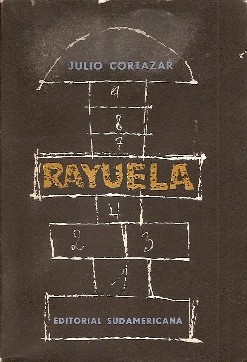


This emphasis on the present moment links in nicely with the quote from Rayuela which I used to close the last entry: "We must establish ourselves in the present once more." I think the central struggle of "Rayuela" (which I finally finished last week) is exactly that, how to fully enter the present moment of time. Oh god, I don't even know where to begin saying even a quarter of what there is to say about this book. (I feel like so many of my reviews begin with that sentiment.) I do know that I am definitely going to have to read this again. (Again, another phrase that is popping up more and more often here.) What do I say about Morelli, the author-like figure who dominates the 99 "expendable" chapters that readers "hopscotch" through?

My favorite thing about this novel was definitely the rapport between the groups of friends. Cortázar does an excellent job of capturing the rambling dialogue of friendships that have lasted a long time. This characteristic is closely related to the other aspect I liked best about the novel, which was how much it reminded me of Bolaño. As I wrote earlier, characters sitting around, drinking, bitching, wandering, pontificating: it all feels very relevant to the mid-20's, post-college lifestyle.

I have no idea where I read this (somewhere online--I swear!), but I read a quote by Cortázar, in which he said that "Rayuela" was his homage to people of his bohemian generation, and how they dealt with whole getting old and feeling irrelevant and purposeless. He also said that it was interesting that it was the young Latin American youth of the 60's who ended up really connecting with his book, as opposed to his generation. (I am gonna try to find the source for this quote, I swear.)

I dunno, it all makes me think of this letter from my favorite advice column, and how the advice he gives is really true. When I read old entries from this blog, or my paper journal, or my livejournal, or any of the 1001 ways that I've tried to record all the craziness that goes on in the small box of consciousness that I call Myself and My World, what keeps coming up for me, again and again, is how I've changed. In this case, change is definitely, definitely a good thing. I am so unspeakably and inexplicably glad and relieved that for whatever reason, over the past year I have significantly drifted away from the crushing pressure of the assumptions that Cary Tennis critiques in his column. Doing well at tasks does notbring us happiness. These preconceived, ridiculous standards and notions of what it means to "succeed" and be a successful college graduate are just... they make me want to vomit in my mouth a little. I'm smart enough to know now that it's not a game... but if it were, I'd definitely say that I'm winning. (And not in what you'd consider the traditional way, either.)

And so again: here's to not always looking to the future and instead embracing the prsent. It's Wacky Water Week with the 8 & 9-year-olds this week at the Club, and it's gonna be a week they'll never forget.

Sunday, July 26, 2009

Rayuela, Part I

It's so hot in Portland right now there's little else I want to do other than sit in front of the fan and eat popsicles from the little Mexican tiendita. Corey and I will probably swallow our hypochondria and go swimming in the public pool down the street later this afternoon.

In a way, I guess it's good that this feels like an exceptionally hot summer in Portland (according to Corey and other long-time PDX dwellers; this is only the second summer I've spent in Portland). Last week I learned that for my internship in the fall with Kiva, I'll be interning with Fundación para la Vivienda Progresiva (FVP), in Nuevo Laredo, Mexico. So it looks like I'm heading back to the U.S.-Mexican border after all... interesting how these things work out. I'm going to have to make myself some cut-offs and buy some more wife-beaters to prepare for life in the desert.

I like how my life's narrative is increasingly becoming defined by the quest for the random and marginal... I'm not exactly sure how all these experiences I'm seeking are supposed to add up to make a coherent, cohesive whole, but then again I'm not sure if I want it to.


This quest for the weird and marginal feels particularly relevant to me, maybe due to the current Big Book I'm reading, Julio Cortázar's Rayuela (or Hopscotch). My sister read this book way back in the day in high school, and then read it again three years ago in Spain. She told me that although she enjoyed it when she read it the first time and knew with certainty that it was a great book, she didn't "get it." As I read it for myself now, I can easily see how there's a lot of stuff here that would make a nice big whooshing sound as it flew over a ninth-grader's head (like what happenned to me and Lolita when I read it in eighth grade and totally didn't "get" the beautiful, erotic love story). I've been reading it in Spanish, and while it's been slow going, almost frustratingly so at times, it's been much more rewarding than reading it in English.

The most exciting aspect of this book is its similarity to the Choose Your Own Adventure series. As the little note by the author on the first page informs us, there are two different ways of reading the novel. In Reading #1, you can read it straight through to Chapter 56, “at the close of which are three garish little stars which stand for the words The End.” (All excerpts from the novel in English are taken from Gregory Rabassa's 1986 translation.) In Reading #2, you begin with Chapter 73 and then hop around the chapters (including Chapters 57-155, described as “expendable), based on the little number printed at the end of each chapter. If you confront the list at the beginning, the one that lists the order in which you'll read all the chapters for Reading #2, you'll discover that you'll eventually be suspended in an infinite loop, hopping back and forth between Chapter 58 and Chapter 131. I'm only on Chapter 37, ending Park One (Del lado de alla/“From the Other Side”) and beginning Part Two (Del lado de aca/“From This Side”), but I'm interested in seeing where I'm going to end up inevitably suspended. It's all really quite ingenious.

Other competitors for the Trippy WTF literary devices category include chapter 28, which skips from page 162 to page 179, without explanation. As this is the chapter when an important character is found dead, I'm assuming these missing pages have something to do with this. To make things even weirder, in the English translation I have checked out for reference, these pages are included. I haven't read them for fear of “spoiling” something that will later be revealed to me as the book progresses, but still, how strange! Where did these pages come from? Are they still waiting for me somewhere, lurking in the back of the pages I have yet to read? Where on earth did the English translator get them from? What a weird situation. At least it highlights the dramatic contrasts that can be found between reading a book in the original language versus the translation (the other translation problem I have with is the translation of “papas fritas” as “fried potatoes”--wouldn't this be French fries? What do you call “fried potatoes” in France?).

Chapter 34 is also an excellent candidate for one of the weirdest reading experiences of my life. So that you can try it out for yourself, here's an excerpt:

"IN September of 1880, a few months after the demise of my
AND the things she reads, a clumsy novel, in a cheap edition
father, I decided to give up my business activities, transferring
besides, but you wonder how she can get interested in things
them to another house in Jerez whose standing was as solvent
like this. To think that she's spent hours on end reading tasteless
as that of my own; I liquidated all the credits I could, rent out
stuff like this and plenty of other incredible things, Elle and
the properties, transferred my holdings and inventories, and
France Soir, those sad magazines Babs lends her. And moved to
moved to Madrid to take up residence there. My uncle (in truth
Madrid to take up residence there, I can see how after you swal-
my father's first cousin), Don Rafael Bueno de Guzman y Ataide,
low four or five pages you get in the groove and can't stop read-"


(Rabassa 191) If you figured out that you're supposed to read this by skipping every other line, then you're a lot smarter than me (to be fair I was reading it in Spanish, and I kept plunging gamely on with the hope that this was some kind of avant-garde rap and that it would begin to make sense to me eventually. The broken-up words like “swal-” and “read-” were what eventually gave it away). How clever, no? As you go on reading this chapter, you realize that the odd lines are from one of the trashy novels that Magda loves to read, and the even lines are Horacio's interior monologue as he reads the very same lines that you've just read, criticizing the book as he reads it (like with the Madrid sentence in the passage above). How clever, no? I don't know if I've ever come across a better attempt to reproduce the experience of reading, by means of spatial arrangement right there on the page. On the last page the lines from the trashy novel drop off and you're left with Horacio, imagining himself and Magda wandering around the city but never meeting, “two points lost in Paris that go from here to there, from there to here, drawing their picture, putting on a dance for nobody, not even for themselves, an interminable pattern without any meaning.” (197) There you have Part 1 of Rayuela in a nutshell: aimless wanderings, a quest for a missing center, the lack of meaning, the concern with geometry.

This is a good book to be reading following the graduation of college. There's a lot of sitting around and Bolano-esque talking, smoking cigarettes, drinking, wandering through the streets of Paris and the eating of fried eggs and potatoes (I love it when authors inform us of what their characters like to eat; Bolano and Murakami are masters of this). There's a lot in the book about wandering around without any direction. The main narrator so far is Horacio Oliveira, an Argentinian writer who lives in Paris with his Uruguayan girlfriend, La Maga. He spends a lot of time either walking around Paris with la Maga, hanging out with his group of bohemian friends who call themselves “El Club,” and having weird and random adventures, like in Chapter 23 when he attends a concert by an eccentric modernist pianist. Part 1 ends with a death, Maga's disappearance, and Horacio's Dante-like descent into degradation and sordidness, which ends with him getting deported back to Argentina. We'll see what Part 2 has in store for him.

Horacio is definitely looking for something. As la Maga tells him, “I think I understand you... You're looking for something you don't know. I've been doing the same thing and I don't know what it is either. But they're two different things.” (76) I like the part when Horacio ponders that “this mate might show me where the center is.” (78) There's this the very Borges-esque thread running throughout the novel, the Argentinean preoccupation with the search for an absent center, the desire to come back to an origin, the desire to understand, the desire for meaning. Ironically enough, while searching for these very structured concepts, Horacio also stubbornly rejects “the idea of unity [which] was worrying to him because it seemed so easy to fall into the worst traps.” (79) Much is made of Maga's lack of intellectualism, but as Oliviera observes, while he imposes “the false order that hides chaos, pretending that I was dedicated to a profound existence while all the time it was one that barely dipped it toes into the terrible waters. There are metaphysical rivers, she swims in them ... I describe and define and desire those rivers, but she swims in them. I look for them, find them, observe them from the bridge, but she swims in them. And she doesn't know it.” (95) There's a lot to unpack there, but suffice it to say, it sure does sound pretty. There's also a lot of Buddhist-related meditations on death and connectedness and the importance of the present moment, which surprised me.

There's lots more I could say about this, but I think I'll leave it at that, mainly it's currently the hottest part of the day and it looks like we'll be going swimming after all. Time to return to the present moment.

“My hand pokes around the bookcase... I take down Roberto Arlt... Today fascinates me, but always from the point of view of yesterday (did I say phascinate?), and that's how at my age the past becomes present and the present is a strange and confused future where boys in baggy sweaters and long-haired girls drink their cafes-cremes and pet each other with the slow gracefulness of cats or plants.
We must fight against this.
We must establish ourselves in the present once more
.” (94)