Showing posts with label labyrinths. Show all posts

Sunday, July 26, 2009

Rayuela, Part I

It's so hot in Portland right now there's little else I want to do other than sit in front of the fan and eat popsicles from the little Mexican tiendita. Corey and I will probably swallow our hypochondria and go swimming in the public pool down the street later this afternoon.

In a way, I guess it's good that this feels like an exceptionally hot summer in Portland (according to Corey and other long-time PDX dwellers; this is only the second summer I've spent in Portland). Last week I learned that for my internship in the fall with Kiva, I'll be interning with Fundación para la Vivienda Progresiva (FVP), in Nuevo Laredo, Mexico. So it looks like I'm heading back to the U.S.-Mexican border after all... interesting how these things work out. I'm going to have to make myself some cut-offs and buy some more wife-beaters to prepare for life in the desert.

I like how my life's narrative is increasingly becoming defined by the quest for the random and marginal... I'm not exactly sure how all these experiences I'm seeking are supposed to add up to make a coherent, cohesive whole, but then again I'm not sure if I want it to.


This quest for the weird and marginal feels particularly relevant to me, maybe due to the current Big Book I'm reading, Julio Cortázar's Rayuela (or Hopscotch). My sister read this book way back in the day in high school, and then read it again three years ago in Spain. She told me that although she enjoyed it when she read it the first time and knew with certainty that it was a great book, she didn't "get it." As I read it for myself now, I can easily see how there's a lot of stuff here that would make a nice big whooshing sound as it flew over a ninth-grader's head (like what happenned to me and Lolita when I read it in eighth grade and totally didn't "get" the beautiful, erotic love story). I've been reading it in Spanish, and while it's been slow going, almost frustratingly so at times, it's been much more rewarding than reading it in English.

The most exciting aspect of this book is its similarity to the Choose Your Own Adventure series. As the little note by the author on the first page informs us, there are two different ways of reading the novel. In Reading #1, you can read it straight through to Chapter 56, “at the close of which are three garish little stars which stand for the words The End.” (All excerpts from the novel in English are taken from Gregory Rabassa's 1986 translation.) In Reading #2, you begin with Chapter 73 and then hop around the chapters (including Chapters 57-155, described as “expendable), based on the little number printed at the end of each chapter. If you confront the list at the beginning, the one that lists the order in which you'll read all the chapters for Reading #2, you'll discover that you'll eventually be suspended in an infinite loop, hopping back and forth between Chapter 58 and Chapter 131. I'm only on Chapter 37, ending Park One (Del lado de alla/“From the Other Side”) and beginning Part Two (Del lado de aca/“From This Side”), but I'm interested in seeing where I'm going to end up inevitably suspended. It's all really quite ingenious.

Other competitors for the Trippy WTF literary devices category include chapter 28, which skips from page 162 to page 179, without explanation. As this is the chapter when an important character is found dead, I'm assuming these missing pages have something to do with this. To make things even weirder, in the English translation I have checked out for reference, these pages are included. I haven't read them for fear of “spoiling” something that will later be revealed to me as the book progresses, but still, how strange! Where did these pages come from? Are they still waiting for me somewhere, lurking in the back of the pages I have yet to read? Where on earth did the English translator get them from? What a weird situation. At least it highlights the dramatic contrasts that can be found between reading a book in the original language versus the translation (the other translation problem I have with is the translation of “papas fritas” as “fried potatoes”--wouldn't this be French fries? What do you call “fried potatoes” in France?).

Chapter 34 is also an excellent candidate for one of the weirdest reading experiences of my life. So that you can try it out for yourself, here's an excerpt:

"IN September of 1880, a few months after the demise of my
AND the things she reads, a clumsy novel, in a cheap edition
father, I decided to give up my business activities, transferring
besides, but you wonder how she can get interested in things
them to another house in Jerez whose standing was as solvent
like this. To think that she's spent hours on end reading tasteless
as that of my own; I liquidated all the credits I could, rent out
stuff like this and plenty of other incredible things, Elle and
the properties, transferred my holdings and inventories, and
France Soir, those sad magazines Babs lends her. And moved to
moved to Madrid to take up residence there. My uncle (in truth
Madrid to take up residence there, I can see how after you swal-
my father's first cousin), Don Rafael Bueno de Guzman y Ataide,
low four or five pages you get in the groove and can't stop read-"


(Rabassa 191) If you figured out that you're supposed to read this by skipping every other line, then you're a lot smarter than me (to be fair I was reading it in Spanish, and I kept plunging gamely on with the hope that this was some kind of avant-garde rap and that it would begin to make sense to me eventually. The broken-up words like “swal-” and “read-” were what eventually gave it away). How clever, no? As you go on reading this chapter, you realize that the odd lines are from one of the trashy novels that Magda loves to read, and the even lines are Horacio's interior monologue as he reads the very same lines that you've just read, criticizing the book as he reads it (like with the Madrid sentence in the passage above). How clever, no? I don't know if I've ever come across a better attempt to reproduce the experience of reading, by means of spatial arrangement right there on the page. On the last page the lines from the trashy novel drop off and you're left with Horacio, imagining himself and Magda wandering around the city but never meeting, “two points lost in Paris that go from here to there, from there to here, drawing their picture, putting on a dance for nobody, not even for themselves, an interminable pattern without any meaning.” (197) There you have Part 1 of Rayuela in a nutshell: aimless wanderings, a quest for a missing center, the lack of meaning, the concern with geometry.

This is a good book to be reading following the graduation of college. There's a lot of sitting around and Bolano-esque talking, smoking cigarettes, drinking, wandering through the streets of Paris and the eating of fried eggs and potatoes (I love it when authors inform us of what their characters like to eat; Bolano and Murakami are masters of this). There's a lot in the book about wandering around without any direction. The main narrator so far is Horacio Oliveira, an Argentinian writer who lives in Paris with his Uruguayan girlfriend, La Maga. He spends a lot of time either walking around Paris with la Maga, hanging out with his group of bohemian friends who call themselves “El Club,” and having weird and random adventures, like in Chapter 23 when he attends a concert by an eccentric modernist pianist. Part 1 ends with a death, Maga's disappearance, and Horacio's Dante-like descent into degradation and sordidness, which ends with him getting deported back to Argentina. We'll see what Part 2 has in store for him.

Horacio is definitely looking for something. As la Maga tells him, “I think I understand you... You're looking for something you don't know. I've been doing the same thing and I don't know what it is either. But they're two different things.” (76) I like the part when Horacio ponders that “this mate might show me where the center is.” (78) There's this the very Borges-esque thread running throughout the novel, the Argentinean preoccupation with the search for an absent center, the desire to come back to an origin, the desire to understand, the desire for meaning. Ironically enough, while searching for these very structured concepts, Horacio also stubbornly rejects “the idea of unity [which] was worrying to him because it seemed so easy to fall into the worst traps.” (79) Much is made of Maga's lack of intellectualism, but as Oliviera observes, while he imposes “the false order that hides chaos, pretending that I was dedicated to a profound existence while all the time it was one that barely dipped it toes into the terrible waters. There are metaphysical rivers, she swims in them ... I describe and define and desire those rivers, but she swims in them. I look for them, find them, observe them from the bridge, but she swims in them. And she doesn't know it.” (95) There's a lot to unpack there, but suffice it to say, it sure does sound pretty. There's also a lot of Buddhist-related meditations on death and connectedness and the importance of the present moment, which surprised me.

There's lots more I could say about this, but I think I'll leave it at that, mainly it's currently the hottest part of the day and it looks like we'll be going swimming after all. Time to return to the present moment.

“My hand pokes around the bookcase... I take down Roberto Arlt... Today fascinates me, but always from the point of view of yesterday (did I say phascinate?), and that's how at my age the past becomes present and the present is a strange and confused future where boys in baggy sweaters and long-haired girls drink their cafes-cremes and pet each other with the slow gracefulness of cats or plants.
We must fight against this.
We must establish ourselves in the present once more
.” (94)

Tuesday, March 31, 2009

On Learning


I've been thinking a lot these days about the value of curiosity. During our early getting-to-know-you conversations, I asked Corey how he would describe himself in one word, and he said, "curious." (I didn't know my one word at the time, but now I think it would have to be "dreamer.") But then I just think about this innate curiosity within me and damn, maybe I am just stupid and naive and this is going to get me into trouble, but the joy of wandering lost through the PQ sections of the SE stacks in the Hauser Library, writing book reviews in my stupid blog, rambling with my co-workers about Borges, or just reading, reading, reading, underlining passages, thinking, writing--it brings me a great joy I don't get anywhere else. No one can take that curiosity away from me, you know? It's in me, it is me. I'll always have it. If I have a way to use it, to the best of my ability, I will be happy. And all these ridiculous badges that supposedly constitute prestige and success can never hold a candle to that, ever.

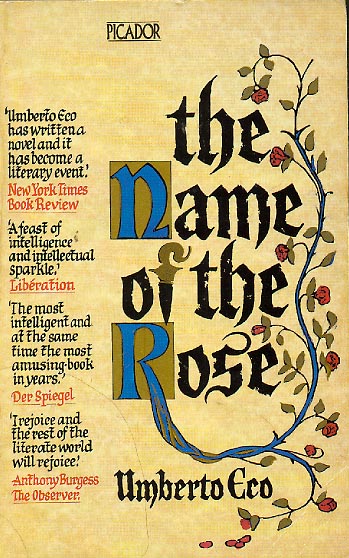
This has been an introspective year for me so far. Having lots of time on the Max to read will do that for ya, I guess. One of the things I've been thinking about lately is the role of books in my life. I just finished Umberto Eco's The Name of the Rose, one of the most glaring titles on my list of Books I Really Should Have Read Already, Don't Know Why I Haven't, Really. In this case, I think it's for the best I waited this long. I definitely got a lot more out of this book with an undergraduate degree.

For one thing, I've read a lot more Borges now than I had in high school, which makes certain aspects in TNOFR like the blind librarian and the labyrinth in the library stand out a lot more (read more about the connection between Borges and Eco here). The introduction is puro Borges and Nabokov, especially in the fictional translator's cheerful pronouncement that the volume lacks any relevance for our present day. Another benefit of my undergraduate education are the lit theory classes, which makes the book's discussion of the roles of signs a lot more interesting. The part where William identifies the abbot's horse (by means of the tracks he left behind in the snow and the flustered monks pursuing him for example) is really ingenious, demonstrating (in William's view) how the universe speaks to us quite clearly through signs. The main question that he (and Borges, and Nabokov) grapple with is how to interpret those signs—is there any order to them, other than the flimsy order imposed by our own minds to make our surroundings seem meaningful? (Probably not.) What is the value of interpretation? Can it ever arrive at any definitive truth, or will it just go on and on forever? (Probably yes. But that's not to say that some interpretations are more valuable than others—read Eco's thoughts on this here, an interesting talk that may be a little confusing if you haven't read his books.)*

The other thing I found unexpectedly intriguing in TNOTR was its discussion of “simple people.” I'd just re-read “Siddhartha” for the first time since high school a couple of weeks ago, and Hesses uses the same term, to refer to people who are purely controlled by their desires. That is to say, people who go through life controlled by what they want: get a job, get money, get married, get a house, get a big TV, get a nice car, and so on. Most of the people in the world are like this—not that there's anything wrong with that. It is vital to note that a major part of Siddhartha's enlightenment is that he eliminates his judgment for the “simple people,” and instead of thinking that his way is superior or vice-versa, he simply accepts that they are different. It is not wrong to be one of the “simple more” any more than it is better to be someone like Siddhartha's—they're just different. The ending of “The Curious Case of Benjamin Button” reiterates the same message: “Some of us are dancers, some of us are mothers, etc,” Brad Pitt intoned solemnly in a voice-over. Or as my Grandma Mary is fond of saying, “We're all different, Julie—different strokes for different folks.”

In The Name of the Rose, the “simple people” are discussed in context to how words affect them, in the sense that they can be more easily manipulated by language. People like William are more akin to a class of readers, because he's constantly trying to read the signs around him, as opposed to accept them at face value. Not to sound incredibly arrogant and place myself on the same level of Sherlock Holmes, but I like to think that it's the same drive in me that inspires me to plough through an entire Phillip K. Dick book in one day, or stubbornly struggle with Mario Vargas Llosa's La Casa Verde. I can think of a lot of people who would think it was pretty crazy to spend my time trying to read Ulysses and La Casa verde. In a way, it is kind of silly. But to me, it feels incredibly valuable and important and precious and there is really no other way I'd rather spend my hours here on Earth: thumbing through these books, inhaling them into their brain, thinking about their words, wondering about their effects and their relation, among each other, among societies, and with me. If I had to describe myself in one word, it would be “dreamer.” I'm just not settled yet, you know? A lot of us aren't. Me, I have little clouds floating out of my ears...

I've been trying to think of a way to explain why books are so personally appealing to me, mainly because my co-workers keep asking me how I liked majoring in literature, and I always respond immediately that I loved it, that it was great, and then my answer to their follow-up question of “why?” is always hopelessly confabulated. Here's one of the reasons I came up with: I was thinking that one of the things you will never be able to do while you are alive on this earth as a human being is to see yourself through another people's eyes. You are always going to be you, indefinably and inexhaustibly you, tied to the ego of your self, your memories, your desires, all the little building blocks that construct you as a person (many of which you are probably not even aware of—maybe that's what life is for, trying to figure out what those tiny little building blocks are). As close as I am to people like my sister and Corey, I'm never going to know what it's like to *be* Corey—to be inside his head, to see the world as he sees it, to know what he's thinking at any random moment. There's this really interesting part in Wizard of the Upper Amazon where during his shaman training, the main character drinks ayahuasca in many ceremonies and learns what it's like to be different animals: anacondas, jaguars, pink river dolphins. At one point he goes inside the mind of everyone in the tribe, and this experience helps him become an especially emphatic and alert healer. Thus, therein lies some of the magic of reading. On one level, reading purports to allow you to “see” the world through another's eyes. I will never know what it's like to be an Italian monk in the 13th century, trying to solve a seemingly unsolvable mystery. But goddamn, I probably know more now that I would have if I'd never read it. Reading is a gateway, a vehicle to different experiences that I otherwise would never be able to have.

Another joy of TNOTR was recognizing myself in the characters. Yes, I definitely cackled to myself, nodding vigorously in recognition as I thumbed eagerly through the pages—yes, these crazy library people, “men who live among books, with books, from books”--these are my people. As one of the monk puts it, “It's true. We live for books. A sweet mission in this world dominated by disorder and decay.” (112) In contrast to the “simple” people, the monks are presented as the “learned' population, living the so-called life of the mind. (I'm glad that my experience of living the life of the mind didn't end with me drowning in a barrel of pig blood, though it came pretty close at times.)

This discussion of having a certain privileged “learned” population who are particularly good at interpreting makes me slightly uneasy, because to me it automatically raises the question of authority: what happens if authoritative interpretations, as designed by this select group, gets in the way of individuals interpreting for themselves? I'm not necessarily thinking of grad school students taking over the world. In one provocative section, Adso discusses learning as something for the few and elect - “Learning is not like a coin, which remains physically whole even through the most infamous transactions; it is, rather, like a very handsome dress, which is worn out through use and ostentation. Is not a book like that, in fact? Its pages crumble, its ink and gold turn dull, if too many hands touch it.” (185) Comparing learning to a book that can grow shabby, decayed and eventually crumble from overuse sets up the biggest danger in the end of the novel—namely, people who think that it's better off if certain kinds of learning (found in specific books) are kept solely to themselves, even if it meant having to kill to keep it secret. William has an interesting monologue in which he discusses the problem of giving learning to the simple:

"The simple have something more than do learned doctors, who often become lost in their search for broad, general laws. The simple have a sense of the individual, but this sense, by itself, is not enough. The simple grasp a truth of their own, perhaps truer than that of the doctors of the church, but destroy it in unthinking actions. What must be done? Give learning to the simple? Too easy, or too difficult. The Franciscan teachers considered this problem... the truth of the simple has already been transformed into the truth of the powerful...How are we to remain close to the experience of the simple, maintaining, so to speak, their operative virtue, the capacity of working toward the transformation and betterment of their world?"

Since for William, “the experience of the simple has savage and uncontrollable results...” his solution is that “we must be sure that the simple are right in possessing the sense of the individual, which is the only good kind.” (205) I can see a lot of sense in that. Being a living individual is a unique, singular experience. I will never know what it's like to be you, you will never know what it's like to be me. That's something that really shouldn't get lost--this understanding and appreciation of our unique, singular existence. Nobody quite like you, with your thoughts-visions-dreams, has ever existed, nor will ever exist again. Even if the kids I work with every day don't turn out to be graduate students or university professors, they nontheless deserve to think of themselves as *individuals* who can decide for themselves what they want. They don't have to go into the Army just because that's the authorative interpretation of what they should do with their lives imposed upon them--they are individuals with unique personalities and thus unique decisions (I think you could argue that authorities try to erase this, in order to encourage only one interpretation). I'm probably not making this point as clearly as I want to... but in summary, this book helped me figure a couple of important things out, in unexpected ways. I think I'm slowly but surely coming to terms with my own decentered nature, my detective-like character, my unsettledness, and I'm slowly but surely beginning to learn how I can use those qualities as a gift, not just to better others, but also myself. I may not be any closer to creating any more order in this world, but at least there is the smallest semblance of more order in this poor head of mine.

“Learning does not consist of knowing what we must or we can do, but also of knowing what we could do and perhaps should not do.” (97)

* There's an absolutely crazy anecdote in this talk straight out of Philip K. Dick, where Eco describes an incident in which he found himself living a scene straight out of TNOTR: thumbing through a beat-up old book in his library, its pages stuck together in a gluey fashion, and realizing it was this lost, incredibly valuable translation of Aristotle. This really blew my mind. There is something crazy going on with this whole life-imitates-art business...