Showing posts with label Bolaño. Show all posts

Sunday, June 21, 2009

2666: no angel came


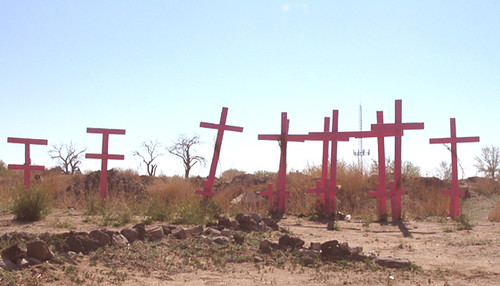
I went to Juarez spring break of 2005. I was a college freshman and the main preocupation of the trip was worrying about whether my Spanish would be accent-free enough to impress the Mexicans, and how much attention my ex-boyfriend (who also came along) would give me. Typical mindframe of the self-absorbed spoiled 19-year-old (I'm being hard on myself, but lah dee dah!). There are a couple of things I remember about the trip. I remember feeling completely terrified as we walked over the border from El Paso into Juarez; I was convinced that as a large group of white kids, we were going to be mugged immediately just walking down the streets (we weren't). I was impressed by how the people for the labor union we interviewed smoked inside their offices. One of them invited us to stay back at their house for the night and I remember being shocked that it was made of mud and tin--I guess I thought that since she wore nice clothes and worked in an office, the house would be nicer. It was very touching. I remember the anarchists whose house we slept in one night and how in awe I was of them. All in all, I think I was too young and inexperienced to absorb or analyze the experience properly. It was experiences like that that make me really believe in the validity of experiential learning: you really gotta get out of your self-absorbed head and experience education for yourself, first-hand. Your early experiences where you're kind of dumb and in over your head are like bricks that you're stacking for experiences later on in life, where hopefully your eyes and ears are a little more open.

In the same way that Che Guevara ate my May, Bolaño has completely swallowed my June. Maybe that's why this entire month has felt so weird and unbalanced to me: how can you expect to be in a sort of stable mind, when you're reading page after page of descriptions of horribly mutilated bodies of women found in the desert? Then you gotta put the book away, get off the Max and then hang out playing with kids for 6-8 hours. Talk about disjointed!

Unsurprisingly enough, there's a lot to be said about this almost 900-pg monster. I'm not even sure where to begin. I kind of feel the way I imagine I would feel after finishing "Ulysses" or "Moby Dick": simultaneously drained and exhilarated. I borrowed the book from a friend, so I couldn't underline any passages or fold the corners of the pages over when I read an excellent quote or a passage that felt particularly meaningful, so that makes me sad, because now, faced with the prospect of this "review", I have this 893-beast in front of me, and I have even less idea of where to begin than I would otherwise. So in advance, let me proclaim I am definitely going to have to re-read this, and thus analysis is definitely going to be very sketchy and first-impressiony, at best.

This book is very different from a lot of Bolaño I've read before--"epic" is definitely the first term that comes to mind. While other Bolaño books felt like the novels that Borges would have written (had he ever written one) "2666" is unmistakably and clearly Bolaño; there's no mistaking his style for another author's. What do I mean by Bolaño's style? I guess when I think of Bolaño, I thinkof the Murakami-like flourishes of what the characters ate or drank for dinner. The plotless plots where nothing really happens and nothing gets explained or resolved. His morbid gloomy view of life contrasted with the fierce joy his characters feel for reading and writing (a characteristic strongly reminiscent of Arlt's "El juguete rabioso" hero). That is Bolaño for me: witty, gloomy, harsh social realism, subtle political commentary, passionate crusader for the validity and worthiness of writing endeavors.

The book is divided into five parts, which all have titles like "The Part about the Crimes" (which unfortunately reminded me of the way "Friends" episodes are titled--the similarity ends there, thankfully!). The first book is the one most similar to the Bolaño I've read before: four literary critics, in the style of "The Savage Detectives", travel to the Mexican-U.S. border town of Santa Teresa (a fictionalized version of Juarez that easily deserves to be mentioned in the same breath of Macondo and Santa Maria) to track down an obscure German author, who may or may not have been last seen there. "I know the two of you will understand," is the last sentence in book one, but we don't.

Out of the five books, the fourth (the one documenting all the murders) is ironically both the most gripping and the most difficult to read. I feel sick about myself typing this, but it gets almost boring, turning the pages: oh, another murder, another death by strangulation, another unidentified decomposed body in the desert, another closed case, another police investigation that goes nowhere... I rached a point where I just felt numb reading name after name after name. The deaths quickly come to seem depressingly similar. Anally and vaginally raped. Body unclaimed and unidentified. Maquiladora worker. Eleven, twelve, thirteen, fifteen, sixteen, seventeen, twenty, thirty-three years old. Bolaño isn't stupid, so this numbing effect is obviously what he was going for. What Bolaño does with thepolice detective genre is very intriguing, as he writes in this very matter-of-fact, CSI-documentation tone. The following quote is a pretty good example of most of the descriptions of the deaths:

In the middle of November the body of another dead woman was discovered in the Podesta ravine. She had multiple fractures of the skull, with loss of brain matter. Some marks on the body indicated that she had put up a struggle. She was found with her pants down around her knees, by which it was assumed that she'd been raped, although after a vaginal swab was taken this hypothesis was discarded. Five days later the dead woman was identified. She was Luisa Cardona Pardo, thirty-four, from the state of Sinaloa, where she had worked as a prostitute from the age of seventeen. She had been living in Santa Teresa for four years and she was employed at the EMSA maquiladora.

And so on and so forth in the longest chapter of the book. Anyway, so it's interesting that Bolaño uses this detective tone to describe this very physical, material evidence in the form of mutilated bodies, and yet despite all their materiality, this bodies embody absence more than anything else: there's no explanation for how they got there, no solution for the crime, and no resolution. Meaning is ecliped and absent despite this very matter-of-fact, supposedly transparent prose. Again: talk about disjointed.

This treatment of meaning (or as my blogspot tag puts it, "the form of truth") by Bolaño is something that definitely deserves a lot more thought (and not just because of his professed admiration for Borges, who loved writing his way out of stories without centres). For a lot of modernist authors (like Kafka and Conrad and so on), meaning was still around recently enough for them to still be pretty bummed about it draining away. That's why so much of modernist fiction seems to centered around the absence of meaning, something empty and silent and critical: hence the empty caves in E.M. Forster's India, Joseph K's crime, Virginia Woolf's lighthouse, Onetti's goat, Godot, Addie's monologue. There's definitely still traces of that critical silence and absence here in Bolaño. One of the questions I have is whether or not Bolaño he sees this absence of meaning as something to be all angsty and anguished about, or whether he sees literature and fiction as sufficent compensation for the disorder and meaninglessness of the world.

On that note, I think one of the most important things to mention when discussing what makes something "Bolaño-esque" is his use of absurdity. In the face of some things that could just never make any coherent sense (like why someone would shove a metal pole up at 12-year-old girl or bite a woman's nipple off and dump her body in the desert), sometimes absurdity is the best (and perhaps only) option. By absurdity, I mean all the extraneous details that go on for pages and pages: what characters dreamt last night, and all the random people who pop in for one scene of the novel and just as quickly pop out, never to be seen again (WTF is up with the psychic lady on TV? The Indian carpet-vendor girl one of the literary critics falls in love with? I could go on and on).

Another thing to consider when trying to define the Bolaño-esque is this quote by the one and only Eric Blair: "a novelist who simply disregards the major public events of the moment is generally either a footler or a plain idiot." With his use of Santa Teresaa as his stand-in setting for Juarez, Bolaño is definitely making very powerful political commentary about violence and power. I see violence as one of the main themes in this book: this dark beast that we have in all of us, which we need to get in touch with in healthy ways (a la Pip from American Doll Posse), but when we let it take control of us--yikes. Even the first book, the one about the literary critics, has this very interesting passage where they randomly beat the shit out of this Pakistani taxi driver. No one escapes, it seems, irregardless of your literary and academic pretentions.

The second book ("The Part About Amalfitano") is a character study of a university professor who may or may not be going crazy. It felt like the most random of the five parts to me. The image at the center of the second book involves a geometry book being hung out on a laundry line, slowly getting eroded by the elements as the professor waits to see how long it takes for the desert to destroy literature (this feels like a very important metaphor for the rest of the novel to me: how does literature stand up to the eroding, corrosive effects of the really harsh, fucked up reality that is our everday lives?).
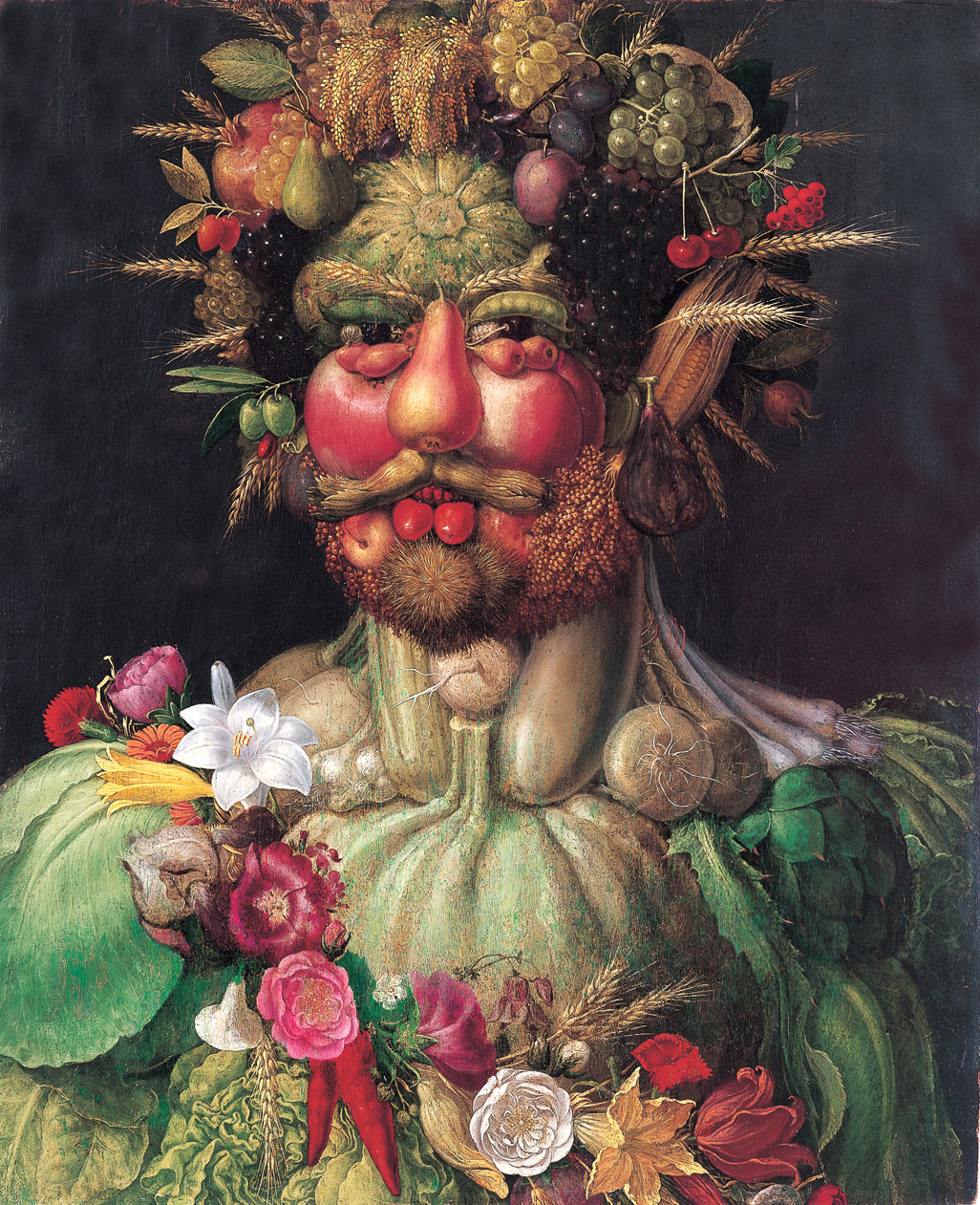

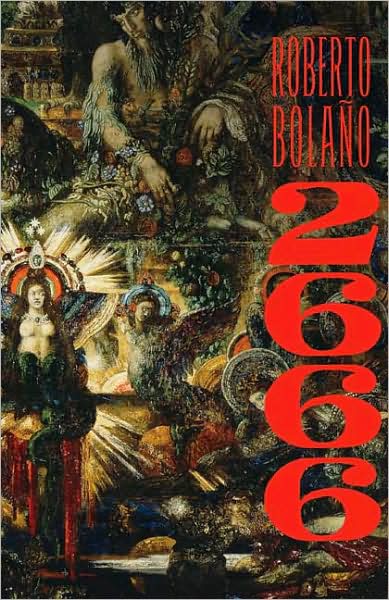
The fifth book is the the one about the German author, Archimboldi, whose name is apparently a homage to the the painter Archimboldo, whose work is depicted in the picture above--his paintings are of individual subjects that together form an apparent whole, just like how the five Parts in 2666 are meant to form one entire work. This book is the most surreal and dream-like. What to make of the last 3 pages? Why does this book end with a guy in a park talking about the different ice cream flavors his ancestor? Is it a commentary on the impermenance of art? The randomnee of life? A homage to Cesar Air and his fondness for strawberry ice cream in How I Became A Nun? Man, I don't know! Good God, give me a place in a PhD program and maybe I'll give it my darndest to figure it out!

"Apocalyptic" is another word that comes to mind for this book. When one of my co-workers saw the cover, he asked me if it was a book about the devil. "It doesn't seem to be yet," I answered honestly. I haven't even touched upon all the apocalyptic imagery and references to the Four Horsemen and the reoccurring images of the abyss and voids that keep coming up, again and again (as the review in Slate handily pointed out). Mental institutions and jails also appear in each of the five books, so I think that's probably important as well. There's also a lot of scenes that play with light and dark: on the last page, "Suddenly the park lights came on, as if someone had tossed a black blanket over parts of Hamburg." (893) Similarly, on the last page of Book 4 (The Part about the Crimes), "Some of these streets were completely dark, like black holes, and the laughter that came from who knows where was the only sign, the only beacon that kept residents and strangers from getting lost." (633)

For Bolaño, is literature the only beacon that keeps us from getting lost? Why else would the story of writers (university professors, academics, journalists, authors) be juxtaposed with the story of these crimes? Does Bolaño think fiction can save us, or is it a petty refuge, a distraction from the savageries of realism implemented by bourgeoise folks like the Jesuit priest in By By Night in Chile in order to distract us from the torture going on beneath the floorboards of our houses? In By Night in Chile and Distant Star, the violence always took place "off-screen." In contrast, the violence in 2666 is very front and center. I think that's why Germany plays an important role in the fifth and final book: if you want to write a book about torture and mass crimes and the apocalyptic end of eras, then yeah, WWII Germany is about as good of a setting as it gets. "The bones, the cross, the bones," is all one character can say in face of it all, and that's about as close to the the expression "the horror! the horror!" that Bolaño gets.

A lot of people are going to write their doctoral dissertations about this book in the next 5-10 years. This book makes me feel proud to be alive during the period in which it was written.

For further reading:
- A list of all the names of the women who have been murdered in Juarez, from 1993-2006, with a brief synopsis of death.
- Very good article from the Nation about 2666.
- The best article on Juarez I've read on the Internet, written for Salon by Max Blumenthal.
- Tori Amos' solo performance of her song "Juarez" from 1999--she looks like she's about to burst into tears at the end.

Sunday, May 31, 2009

Never Stop Reading: I Must Give So I Can Live

"We never stop reading, although every book comes to an end, just as we never stop living, although death is certain."


It feels good to end the month on a high note! Yesterday Laura and I got dirty from digging her garden, walked down Alberta St., drank a lot of coffee, had Happy Hour at the Tin Shed, and wandered into a music instrument store. Laura has her heart set on getting an oud but alas, her quest has been a bit hard-going. I'm pretty sure I'm going to get a keyboard, because it's a) cheaper than a banjo and b) I already know how to play it, you know? Sometimes, laziness does play the winning card.

I'm pretty excited about June and the summer in Portland. The Boys & Girls Club is closed for the next two weeks for summer maintenance and to get ready for summer programming, so that's been a nice little break, albeit a bit boring (there's only so much dusting one can do without getting bored). Right now it's so unbelievably hot in the house I'm not sure how much more of this getting-caught-up on silly computer stuff I can take, but I'm sitting in front of the open window where there's a nice breeze so I'm gonna give it my best shot.


How I Became A Nun by Cesar Aira

This is the weirdest book I've ever read in my life. I can definitely see why the Bolaño rave is on the front cover. The back cover summarizes the book as "a modern day 'Through the Looking Glass,' that begins in cyanide poisoning and ends in strawberry ice cream." That's probably about as good as a summary you're going to get.

It's also important to mention that although the main character has the same name as the author, it's never clear whether the narrator is male or female (she appears as a female more often than not). The NY Times book review focuses on this gender ambiguity quite a bit, viewing it as the key unspoken part of the novel: namely, more than anything else, this book is about a girl trapped in a boy's body. I don't know if this interpretation is what Aira intended, but it definitely makes for an interesting reading.

I liked the first chapter, involving said cyanide poisoning. The last chapter, involving a kidnapping, is quite Fargo-esque. The main word I would use the describe this book is "surreal." Or maybe "dream-like." What's up the section involving the main character's friendship with a boy who likes to play dress up with a plastic nose and his grandmother's teeth? What to make of the character's inability to "read" when he/she rejoins kindergarten, after his/her extended hospital stay? What does the title refer to? (The NY Times book review thinks it's a reference to Spanish picaresque novels.) What to make of this book, period? Damn, I've never read anything quite like it, and it's doubtful that you have either. It's pretty damn cool to read contemporary fiction like this.

Rating: Read This Book Before You Die


A Mercy by Toni Morrison

I OWN I am shock'd at the purchase of slaves,
And fear those who buy them and sell them are knaves;
What I hear of their hardships, their tortures, and groans,
Is almost enough to draw pity from stones.
I pity them greatly, but I must be mum,
For how could we do without sugar and rum?

(William Cowper, Pity for Poor Africans)

How could we do without sugar and rum? I mean, we like sugar and rum, right? We like our little comforts. They make our lives easier. We don't need them on the level as we do, say, shelter and food and warmth, but they sure do make our lives a lot better and a lot more comfortable. And when it's our own ease and comfort that's at stake, it gets very, very trick when we start considering where that comfort comes from, and at what cost.

This is just one of the questions asked by this very powerful, well-written book. Toni Morrison kind of reminds me of Tori Amos, in the sense that they can both pump out these absoultely brilliant masterpieces with an ease that would be monumental and earth-shattering for any other author. This book reads as a very effective companion/prequel to "Beloved." There's a lot to like here: the Faulknerian narrative, the poetic language, the history of early European settlement and the beginnings of slavery on U.S. soil, some Bruce Springsteen-worthy imagery of a man's dream house rising on a hill above the Virginia fog, a New World-esque motif of a girl struggling to fit into and get used to her shoes. Themes dealt with include debt, freedom, family, and ultimately how “to be given dominion over another is a hard thing; to wrest dominion over another is a wrong thing; to give dominion of yourself to another is a wicked thing.”

This book made me think a lot about Power and how I use Power in my everday life. There's this essay by George Orwell called "Such, Such Were the Joys," in which he describes how his experiences at prep school were his earliest experiences of fascism. Blind Justice being dealt out arbitrarily, for no rhyme or reason that you can see. Sometimes I feel like I'm teaching kids about Facism at my job. "Line up, it's time to go to meeting!" "But why?" they ask. "Why can't I just run around screaming? Why can't I just throw things on the floor? I don't like him, why do I have to stand next to him? Why? Why? Why?" It all must seem very silly, these exercises in How To Be A Socialized Polite Human Being I'm responsible for implementing, day in and day out. I think in the end, as Tori Amos sings on her new album, "I must give so I can live." A good mantra. You get what you give. You can use power (over yourself and over others) wisely, for good rather than for evil. You can be aware of it and the consequences of abusing power. It can make you appreciate, above all else, your Freedom, all the more so if you're a young woman.

Anyway, in the end I think the less you know about this book, the more you'll enjoy it, because that's one of the things I really appreciated: having no idea where the story was going and being constantly thrilled and awed by the skillful writing and plot development. Damn Toni, you write like a motherfucker, and you put us all to shame. It's the kind of book you put down and stare into space for a while after turning the last page. Highly recommended.

Rating: Read This Book Before You Die


By Night in Chile by Roberto Bolaño

A very memorable, powerful book that asks the very difficult but important question: what is the relevance (if any) of literature to Real Life, especially when said Real Life involves political turmoil? (Specifically a military coup when people are being tortured and killed in basements while literary salon-like parties of the intellectual elite are taking place upstairs.) Is it brave and wise to read Thucycides and Plato when a democratically elected president is being overthrown, or just hopelessly stupid and out-of-touch? With this novella, narrated by a Jesuit priest who gives classes in the history and aesthetics of Marxism to Pinochet after the coup, I can see why Bolaño liked "How I Became A Nun" after reading this book. Oh, Bolaño. You make my life so much better. More than anything else, Bolaño has shown me that truly great literature has a strong connection to the relevant, to what is going on the world.

Rating: Read This Book, Bolaño Fans


Last Evenings on Earth by Bolaño

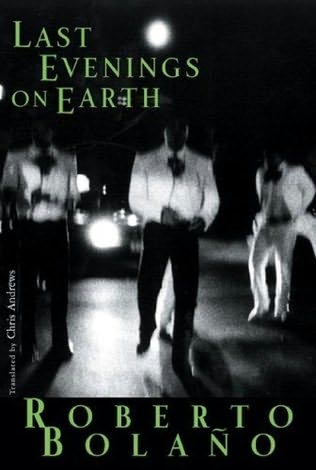
Amazing. Simply amazing. A must-read. Bolaño makes me feel happy to be alive, and how can a book be anything other than amazing if it makes you feel that way? Bolaño's characters fuck, drink, swear, travel, smoke, live in exile, feel homeless and above all else readreadread and writewritewrite. Standout stories include the title one (a contemporary interpretation of Borges' "El sur" ), "Mauricio ('The Eye') Silva" (which reminded me of "The Ministry of Special Cases," in the way it serves as a eulogy for the victims of the "disappearences" in Chile and Argentina), "Enrique Martin" (scary and disturbing, and more than a little Phillip K. Dick-esque), "Anne Moore's Life" (one of the few Bolaño pieces where the main character is female), "Vagabond in France and Belgium" (I liked the ending: "But she doesn't hang up.") and "Dentist," which contains the closest manifesto of Bolaño-esque fiction that he has perhaps ever written, as well as the following extraordinary sentence: "We never stop reading, although every book comes to an end, just as we never stop living, although death is certain." Oh, it just makes me want to sigh happily and hug myself with blissful, satisfied, sated contentment.

(The NY Times book review of this book is particulary well-written and makes for a good introduction if you've never read any Bolaño before.)

Rating: Read This Before You Die, If You Know What's Good For You


Nazi Literature in the Americas by Bolaño

The kind of novel Borges would have written, had he written a novel. Basically, this novel is an encyclopedia of fictional fascist right-wing writers; mostly from Argentina, some from the U.S., Germany, and Chile. Apparently Bolano told an interviewer, "(Its) focus is on the world of the ultra right, but much of the time, in reality, I'm talking about the left.... When I'm talking about Nazi writers in the Americas, in reality I'm talking about the world, sometimes heroic but much more often despicable, of literature in general." A very interesting take. Overall, the book's "gimmick" got a little much for me after 150+ pages. All of author's names started to blur together in my mind. I was slightly confused when I realized that the last chapter is basically the same story as "Distant Star;" I'd be interested in knowing which one he wrote first (I assume this one, as it's much less fleshed out and detailed as DS). I'd recommend this only to Bolaño fans because I can see how it might be tough going for someone who isn't used or into this kind of intensely referential writing (think of the footnotes in "House of Leaves" times 190 pages). The NY Times has another really good, well-written review for both the Bolaño fan and novice; it makes the interesting point that had the Nazis won World War II, this book could very well be true, you know? History is all about the point of view; in the case of this novel, it's from the loser's, which creates poetic irony but also makes it a little disturbing when you consider how it could all so easily be true.

Rating: Read This Book, Bolaño Fans and Followers of Borges


First Stop in the New World by David Lida

I read this book in a day. I'm very impressed with myself (as well as slightly horrified by how much time I spend per day commuting). I heard of this book when Corey and I met the author on the plane back from New Orleans; he was very nice and I am very pleased to say that I enjoyed this book very much! It's the kind of book I wouldn't mind writing myself someday: a nice balance of tone, a journalism and literary hybrid. Man, it sure did make me miss Mexico... those sizzling street tacos, mmmm. This book is about as informative and in-the-know as you're gonna get about the D.F. Lida interviews politicians, the richest inhabitants of the city, glue-sniffing street kids, crack-smoking cab drivers, newspaper vendors, artists and more.

I liked how he made use of Octavio Paz's "The Labyrinth of Solitude" when discussing Mexican culture and Mexican behavior. The use of "masks", both personal and cultural, is pretty central in Paz's essay, and it makes me think of what masks I use in my life. In terms of my cultural/racial heritage, I'm mostly British and Portuguese, with some Irish and German thrown in there. I'm basically a child of Empire. I was inventing this theory with Corey on the Max about how maybe historical and cultural baggage can have a subconscious effect on your own self-perception. Maybe that's why Searching and Self-Absorption and Who-Am-I can be understood as Stuff White People Like: we're all carrying around this weighty historical guilt from facilitating or implementing imperialism and colonialism. This is a really badly articulated argument that was formed when I'd had a few beers, so apologies for that. Anyway, all this reminiscing about Mexico makes me all the more pscyhed to see Luis Alberto Urrea at Powell's books on June 3rd. (The Devil's Highway is a really powerful, great work of investigative journalism.)

Rating: Definitely Read This If You're Interested in Mexico City/Mexico

Sunday, March 15, 2009

Here an Intellectual, There an Intellectual, Where to Put the Intellectual?

The concern of the intellectual is by definition the conscience. An intellectual who fails to understand what is happening in his time and in his country is a walking contradiction, and those who understand but do nothing will have a place reserved in the anthology of tears but not in the living history of their land.--Rodolfo Walsh, Seminario CGT, May 1st 1968


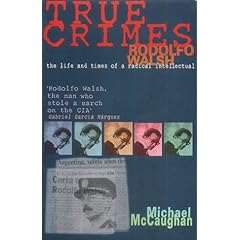
I've been reading a biography of Rodolfo Walsh (True Crimes: Rodolfo Walsh and the Role of the Intellectual in Latin American Politics by Michael McCaughan, Latin American Bureau 2000) which is also an anthology of his fiction and journalism translated into English. Not only has it been an interesting read, but it also has some eerily appropriate parallel themes with my current ponderings. Walsh was an Argentine writer and journalist, born of Irish ancestry and raised in a Catholic boarding school, wrote a In Cold Blood-like non-fiction work called Operacion Masacre, went to Cuba shortly after the Castro revolution in order to work in the news industry there and weirdly enough ended up intercepting a code from the CIA that gave away the location for the Bay of Pigs invasion, abandoned fiction to devote himself full-time to journalism and underground resistance work in the 70's once the political situation in Argentina really went down the drain, and was shot and killed in a shoot-out by the military in the middle of the street (his body was never recovered). He is counted as one of Argentina's 30,000 “disappeared” of that period. Isn't that weird, how you can sum someone's life up like that, in a couple of greatest-hits sentences? (I inevitably wonder what my own sentences will consist of...)

I haven't finished the book yet (I'm at the part where he gets really intensely involved in underground resistance), but there have definitely been some moments in the book that have given me pause and thus merit some reflection here. The short stories are excellent, particularly "Footnote" and "Esa mujer" (check them out). There's a lot of discussion in the book (as indicated by the subtitle) about Walsh's struggle with the role of the intellectual in society, which I found personally quite relevant... I feel uncomfortable about calling myself an “intellectual,” but I definitely read a lot, and like thinking about things that probably a lot of people would consider quite silly, such as “what is the role of the intellectual in society?” (After Barry-O's election and Georgie's reign, this question has been given a bit more attention.) I went to an expensive college, my parents are well-educated. I like reading fiction, writing fiction (goes without saying I need to do this one more), writing and talking about fiction. Yeah... I am pretty much a bourgeois intellectual.

I guess I struggle a lot with how relevant all of this is (the reading and writing and talking about fiction). I like doing a lot of other stuff to, outside of this—I like working with people, I like being with people, I like doing things that feel like they make more of a difference in a day-to-day sense. My job isn't super prestigious or super high paying or anything like that, but someone's got to hang out with these kids and give them something positive in their lives, you know? I dunno, I'll just say that I find it relevant and then leave it at that. My struggle (which I was reminded of again and again in this book) is finding a balance between these two things: the whole isolated hermetic ivory tower writer and intellectual tradition versus the nitty-gritty, down and dirty, involved in the world role. Is there a way to combine the two? Does it really come down to choosing one or the other? Is the role of books in my life destined to be restricted to a hobby, a sideline entertainment, or will it become a career? (The latter's up to me to decide, I guess.) Interestingly enough, in some of the interviews with family members and friends, a lot of them express frustration about Walsh's choice of journalism over politics... there's a certain attitude in their words of "oh, he could have been one of the greatest Argentinean fiction writers, he had so much potential, but then he went ahead and got involved in politics and justice." I don't think there's really a right or wrong choice; it's just a matter of the type of person you are... some of us are content, others of us are a little more scattered and need to explore different roles and careers in order to find that kind of satisfied fulfillment...

I folded over the upper-right corner on the page where Walsh is having a conversation with another young aspiring author, in his early 20's (this really hits home in terms of the theme of this blog):

“These are different times, Nicolas, and this is a time for a bigger undertaking. When you're trying to change important things, then you realize that a short story, a novel, aren't worth it and won't satisfy you. Beautiful bourgeois art! They taught us that it was the supreme spiritual value. But when you have people who gave their lives, and continue to, literature is no longer your loyal and sweet lover—it's a cheap whore. There are times when ... every spectator is a coward or a traitor. This might be a pain for the more intimate questions of the soul but that's the time we're living in.” (218)


You see this same question in a lot of Roberto Bolaño works. I just read La estrella distante (Distant Star), a 140-page novella that makes for a quick and thought-provoking one-day read. This book talks more about writers and poets than anything else, specifically one poet, Alberto Ruiz-Tagle, who gets involved with the Pinochet Regine by writing state-approved poetry in the sky. If you like Bolaño, you should definitely read this work. I never realized how influenced by Borges he was, either. I'm starting to see this as a common denominator in a lot of the stuff I've been reading or re-reading lately (Lolita, The Island of the Day Before). I don't want to give too much away about the book (part of its impact is being shocked by its unexpected development), but the novel deals with the same question discussed in the Walsh biography: what is the relationship between literature and real events? Is turning to literature when unimaginably violent events are taking place in your immediate world brave or just blind and stupid? The insightful New York Times book review of Bolaño's The Savage Detectives makes an important point:
What can it mean, he asks us and himself, in his dark, extraordinary, stinging novella "By Night in Chile," that the intellectual elite can write poetry, paint and discuss the finer points of avant-garde theater as the junta tortures people in basements? The word has no national loyalty, no fundamental political bent; it's a genie that can be summoned by any would-be master. Part of Bolaño's genius is to ask, via ironies so sharp you can cut your hands on his pages, if we perhaps find a too-easy comfort in art, if we use it as anesthetic, excuse and hide-out in a world that is very busy doing very real things to very real human beings. Is it courageous to read Plato during a military coup or is it something else?

Yeah... I'm just trying to figure stuff out, I guess. I am in a certain position of power and privilege, in the sense that I have choices of what to do with my life. And just like in Spiderman, "with great power comes great responsibility." So I am trying to figure what I want to do with my brain, and how I can find something to do with my brain that feels both worthwhile and valuable. So it goes.


Maybe getting glasses is the common denominator behind figuring everything out.