Showing posts with label social justice. Show all posts

Thursday, October 22, 2009

"The highway is alive tonight": Murakami and Steinbeck in Nuevo Laredo


This novel begins with such a normal scene: the narrator in the kitchen, boiling spaghetti and listening to an opera, “which has to be the perfect music for cooking pasta.”(5) There's absolutely no indication in the first 100+ pages that the story is going to end as weirdly as it does.

This was absolutely the most perfect book in the world for me to read at this particular point in my life. The friend who gave it to me told me he'd read it during a time in which his “flow was obstructed,” and I guess the same goes for me. There was just something so warm and reassuring about reading this book. I would be in the office or in the field all day in Nuevo Laredo, learning all these new concepts and absorbing all these incredibly draining, intense experiences, and yet, at the end of the day it would all be okay, because I knew I could come home to my little apartment, sit on my beat-up couch, eat my cornflakes and yogurt and read another 100 pages of Wind-Up Bird. It was like coming home to cuddle a stuffed animal, albeit one that talked a lot about the Japanese military efforts in Manchukuo.

I loved reading this book. *Loved* it. I wanted to hug it to the chest and clap my hands gleefully with happiness, like a happy seal. I love all the different Joycean techniques Murakami employs to tell his tale: computer chats, letters, newspapers, hallucinatory dream sequences. It feels important that the story begins with a very straightforward, realistic narrative that is almost boring in its simplicity: a man begins searching for his wife's missing cat. In the last couple of chapters, you're no longer sure if what's going on is happenning in this world, a parallel universe, inside somebody's head, or inside several people's heads (that's about as spoiler free as I can be). Also, as a history geek, I loved reading the parts about the Japanese army in Mongolia or the Japanese occupation of Manchuria and the prison camps in Siberia. There's so many parts of the world and of history that I have yet to learn about...

My absolutely favorite thing in the world about Murakami is all his descriptions of what the characters eat. A ham, tomato and cheese sandwich. Stir fried green peppers. Coffee, constantly. These little details sounds so simple, and yet they add so much to the story: it grounds it in something that's so real and very much every day. The literary cliche gods help me, but I have to call it Kafkaesque: we believe all the crazy things that happen later, because everything that happens early on is so credible, to the point of being monotonous almost. It really is clever technique.

This is a very postmodern novel in the sense that it deals a lot with the question of the self. As in, do we actually have one? Can you ever actually “know” yourself, let alone another person? More than anything else, I think this is the central question of the novel. It reminded me a lot of Tori Amos' concept album, American Doll Posse, in which she assumes the persona of five different female archetypes, each representing a different side to the female personality. This idea of having several different selves, as opposed to one that is already neatly, conveniently formed, is a theme I believe I've already brought up in this blog. I really like the idea of having this “wise self” inside of me, this very pure, intuitive wisdom that I can turn to, time and time again, in order to reassure myself and calm myself down, make myself feel like everything is going to be all right. What about all my other selves? Is complete integration an illusion? Is being mildly fragmented the best that any of us can ever hope for? The question feels even more relevant if you consider victims of trauma like war (as in Wind-Up Bird) or rape (as in American Doll Posse). Trauma can shatter you, splinter you apart. How do you go about rebuilding yourself, making yourself whole again?


This idea of rebuilding and coming together appears in a very different form of John Steinbeck's The Grapes of Wrath, the other book I looked forward to coming home and reading these past few weeks. Steinbeck is about as straightforward as narrative realism gets, not much I can call postmodern here (though please feel free to correct me!). I liked how this book made me want to listen to Bruce Springsteen (which makes sense, since Bruce Springsteen has obviously read Steinbeck. I was surprised by how easily you could update The Grapes of Wrath to a 21st-century tale of immigration to the U.S., if you just substituted the Joads for a Mexican family, changed Okies to mojados, throw in a scene of crossing the Rio Grande.

Oh, it just makes me sad, it makes me angry, it makes me want to—I don't know, I was going to write “run into the street, burn something, write to a Congressman,” but to be completely honest, what it makes me want to do is read more. I want to read more about the history of labor movements in the early 20th century, I want to read more about the development of 21st-century immigration policy, I want to read more about socialism. I want to sit up late reading drinking my carrot juice, underlining passages in pencil and maybe even scrawling a note to myself in the side margins (yes, I am thus revealing myself to be a book vandal!). I want to read and think and write my thoughts down and them talk about them, late into the night with other people. And then I want them to give me more books to read and tell me, “I think that you would like these ones.” More than anything else it makes me feel hopeful and happy to think that there are other people like this in the world, other people who can relate to the feeling of your heart beating as you hand a book over to another person, the words in your throat bursting with eagerness as you say “oh! This one—you really need to read this one!” What would the world be like, after all, without all these people who want to read great books and think silly thoughts about them and then go out and do completely random-seeming things like intern for a microfinance institution in a border city?

Nobody's fooling nobody about where it goes.

Saturday, September 19, 2009

"poor" people


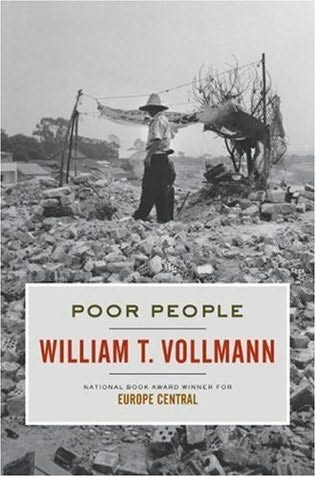
Poor People is not a pleasant read. Indeed, it is a very difficult and challenging read, and I don't doubt that its author intended it that way. There is nothing I can say in critique (or in praise) of this book that hasn't already been said by writers more articulate and with more experience and clout than me. For me, it's enough to read the title and listen to myself as I say it aloud and hear everything implicit and subtly lurking behind that phrase: “poor people. Poor, poor people. Poor! People!” In those words I hear pity, fear and inevitable relief, that the speaker by default cannot be considered as one of the “poor,” since she/he can speak of them as something seperate and apart, something radically other and different from themselves. Disconnected. If you can view others as poor and thus by default radically separate from yourself, are you automatically saying that you by definition must be considered rich?

I read this book in between all the microfinance-related reading I've been doing over the past two weeks or so in preparation for my rapidly impending internship with Kiva (I'm getting on a bus to head to San Francisco for training tomorrow). I've read some pretty interesting stuff (especially the discussions about the commercialization of microfinance and the tension in MF about being focused on economic development or the marketplace, poverty vs. profit). Depressingly enough, I don't think microfinance would offer much in the way of a solution to the “poor people” profiled in this book. To be given a loan to start a business or purchase supplies or improve your house, it's already implied that you have already have started with something, as opposed to absolutely nothing. The people in these book really have nothing: they're the the sickly old beggar women, the smelly drunk and indigent, the crippled, the beggars in subway stations holding out palms or rattling plastic cups full of coins, the refugees, the fevered mothers holding their babies and staring down at the ground before them. God, this book is depressing.

I did not particularly enjoy reading this book, which makes it hard for me to recommend it to people. I first stumbled upon it several years ago, in my stacks-shelving job at the college library. I flipped through the black and white portraits at the end and was intrigued by the number of photos that were of people from Colombia, and it's never really left my mind since. The images of beggar women in burqas in Afghanistan during Taliban rule are definitely remain the most affecting (Vollmann's discussion of poverty-as-invisibility ties in nicely to these images). The strongest bits of this book involve Vollmann-as-reporter, during which he simply profiles the folks he's interviewing. I liked the portrayal of the Russian family in which the husband was too sick from Chernobyl to work, and his foray into an off-limits oil refinery in Kazakhstan has the elements of a really angry documentary. He veers away from this simple reporting in the middle part of the book, instead going off on long tangents from his personal list of what defines poverty, such as “accident prone-ness” and “unwantedness.”

At one point in one of my flights and bus rides (it's hard to keep track of them lately!), I started doodling in my journal a list of WHY SHOULD WE FIGHT AGAINST POVERTY? The main reasons I came up with weren't so much academic as they were from my emotional gut. reason #1: Empathy: we're all born in this crazy ass world without really asking for it, and being that we're all in this sick mess together, we might as well help each other out... be a giver rather than a taker. Reason #2: Karma (in its most simplified definition): by helping others, you're helping yourself, and more importantly you're putting out a little positive energy out there into the black toilet hole of a universe for future use. Not exactly award-winning reasons, but for what it's worth that's what I succeeded in skimming off the top of my curdled-by-Greyhound brain.

I'm sure I'll have a lot more interesting things to say about poverty after I start Kiva internship, which I plan to blog about in more detail than I have so far in this space. In the meantime, one thing that really stood out for me in the wiki biography of Vollmann's life is how he dropped out of a Comparative Literature program at Berkeley “after one year with the intention of engaging life instead of just studying.” What an interesting phrase, “engaging life.” How does one go about doing that, pray? Is life something you just walk around and eventually find if you keep your mind open enough, or do you have to adopt a more proactive, aggressively-seeking approach?

For me at least, life as I've engaged it in the past week has been pretty pleasant, visiting my various girlfriends in Los Angeles and staying with my grandma in San Luis Obispo county. This evening my grandma and I looked at old photographs and I learned about Cosmo and Al, the guys my grandma “went with” before she met my grandfather. Poor Cosmo (a Navy fellow) was rejected on the account of insulting my great-grandfather's lawn, and Al (whom she “went with” for three years—long-term relationship, grandma!) went so far as to get her a ring, a fur coat and some kind of fancy box thing, all of which she rejected because “I didn't have feelings for him that way.” Poor Al.

(You can check out the non-profit(s) I'll be interning for until Christmas here and here.)

Friday, May 22, 2009

Oh, Ernesto


The person who wrote these notes died upon stepping once again onto Argentine soil; he who edits and polishes them, 'I' am not I; at least I am not the same I was before. That vagabonding through our 'America' has changed me more than I thought.


The whole month of May has been swallowed by the 750-page behemoth that is Jon Lee Anderson's biography of Che Guevara. I've been keeping Corey fully updated on the different stages of Che's life for the past three weeks: “Che's bumming around in Guatemala with not much idea of what to do with himself. God, it makes me feel so much better about my life!” “Che just arrived in the Congo. Things are not looking good.”

This whole month of May feels like it just got swallowed. I could write something about how it's been a year since I've graduated and so now I have this great manifesto... but I don't, so I won't.

My favorite part of the book was the first part, entitled “Unquiet Youth,” mainly because it dealt with what I was most interested in: what Ernesto was like as a young man and what drove him to pick his particular life path. This was my favorite part because it was what felt most relevant to me personally, as a young person still trying to figure out the best way to manage my freedom, my privilege and my choices. It was almost with a sense of relief that I read about Ernesto's lack of direction and pervasive sense of uncertainty following his graduation from medical school. I thought it was really interesting that even though Ernesto was surrounded by all these radical Communists, Socialists and Marxists in Mexico and Guatemela, it wasn't until after (as opposed to before, or during) the American intervention/CIA overthrow that he made the decision that he wanted to be more involved. As he wrote in a letter to his mother, “The bad thing is that at the same time I haven't taken the decisive attitude that I should have taken a long time ago, because deep down (and on the surface) I am a complete bum and I don't feel like having my career interrupted by an iron discipline.” (162-163) I almost felt like cheering when I read this: Ernesto gives a big stamp of approval on bumming around for a couple of years!

I thought it was fascinating to read about the gradual formation and changes of Ernesto's sense of self. It was really interesting to me reading about how your childhood can have such a monumental effect on you throughout your life: as a little kid, Ernesto was so constantly sick with asthma, he was babied a lot by his mother, but also developed this incredibly fierce iron will to compete (like in rugby) and be considered as “good” as the other kids. As the biographer describes it, his asthma also led to his sense of isolation and resulting craving for camaraderie, which the author sees as the main reason for Ernesto's fierce adoption of the Cuban cause and intense loyalty to Fidel Castro. Being a guerrilla made him feel like he was a part of a group, that he had friends, he had comrades. God, it makes me wonder how my childhood is affecting my current life. It also makes me wonder if life can really be seen as a narrative this convenient, that this straight lines can be drawn from our childhood right up to the present day. I guess it's helpful to think so.

When Ernesto adopts 'Che' as his name, I couldn't help but think of Into the Wild and Alexander Supertramp. “Call each thing by it's proper name,” he writes in his journal near the end of the movie, signing his death note with his birth name, Christopher. Man, how hard is that, trying to figure out what your proper name is! Talk about easy say, hard do. It's something that might take a lifetime to do.

At one point, one of Che's comrades says, “In spite of everything, you can't help admiring him. He knows what he wants better than we do. And he lives entirely for it.” I think this is an accurate reflection of my own feelings. I could never, ever live like Che Guevara—hell, very few of us could! It takes an incredible iron will to do so. At times, he was a hardcore maniac to the point of insanity, justifying the executions in Cuba as “justice at the service of future justice.” (458) I thought it was funny how he was particularly enraged by “individualistic” university students with “middle-class' mentalities: “perhaps in the students he saw his self-absorbed former self, and it rankled him. He had given up his self, his 'vocation' for the revolution; why couldn't they?” The answer, Che, is we're all different. We are all different people with different paths in life, and it's not helpful to say that one path is better than others or is the “right” path or whatever. Some of us are constantly seeking happiness and contentment, others find it pretty quickly and effortlessly. That's just the way it is. That's what makes us so valuable as human beings, right? Our individual, crazy, unique messed-up selves, these ridiculous consciousness we're carrying around in the mushy gray matter enveloped behind our thick skulls?

In the biography there are some parts that indicate that Che felt isolated at times, like he was living this double life, due to his commitment to the “revolutionary cause.” At one point he says to Alberto (his old travel companion from The Motorcyle Diaries) “I live like someone torn in two, twenty-four hours a day, completely torn in two, and I haven't got anybody to tell it to. Even if I did, they would never believe me.” (608) As he writes to his mother, “I am still the loner I used to be, looking for my path without personal help, but now I possess the sense of my historic duty. I have no home, no woman, no children [I'm sure his wife and daughter were a bit bummed to read this], nor parents, nor brothers nor sisters, my friends are my friends as long as they think politically like I do and yet I am content, I feel something in life, not just a powerful internal strength, which I always felt, but also the power to inject others, and an absolutely fatalistic sense of my mission which strips me of all fear.” (433-434) I don't know if I could throw my life in a similarly all-in fashion in pursuit of one single goal.

It makes me feel so young saying this, but I remember watching The Motorcycle Diaries with my freshman year boyfriend in theaters on our very first date together and being extraordinarily moved. I was particularly struck by the montage of black and white photos at the end of the different people that Alberto and Ernesto. Here's an excerpt from my personal journal that I wrote on March 19th, 2005, (Gaaaah!) shortly after I came back from the spring break service trip to Juarez:

These are some things that I cannot quite get my head around yet:

1) The difficulty between making a connection between what you think and what you do. This is something I was discussing with Ian the other day in the rhodadendron (god help me, I can never spell that word) gardens. It’s very easy to think that “I”m liberal” or “I’m creative” or “I’m a good person”, but if you don’t acutally DO anything physical in this world that serves as a concrete, physical testament to that belief, well then it just doesn’t sound very realistic to say it anymore, innit? This is something that I admire very greatly about Che Guevara upon reading “The Motorcycle Diaries”: say whatever you might like about him, but he was extremely effective at forming a connection between his ideas and his actions. The equal images of a clenched fist and a mouth streaming ideas, resting side by side... I think I’m going to have to check out some books from the library in order to learn more about him and Cuba from a more academic, scholarly point of view, because all I’m going on here is the adoring worship of the people that I’ve been surrounded by throughout my life. I think it’s creepy that “The Motorcycle Diaries” affected me much more than I ever thought it would. At the time I just thought it was a big deal because it was my first American date or whatever, but look at me, I don’t know how many months later and still thinking about it. I guess it must have resonated very deeply within me, and I have this picture of my soul being struck like a guitar string and still quivering back and forth, months later.


I went on to rant a little about how I was changing my major to General Literature or Spanish as opposed to English and Creative Writing, because I felt it would be more useful. I used an interesting phrase, about "learning to balance the Howard Roark and the mother in me." A struggle that still continues to this day. God, I'd forgotten how excruciating reading old journal entries can be. If nothing else, they serve as a reaffirming validation that yes, it is possible for people to change, and yes, I *have* changed since I was a freshman. Thank god. Anyway, I just thought it was funny, reading what I wrote all the way back then, in context of me in the process of finishing this enormous biography.

It was fun reading about Ernesto's early life because his writings were equally melodramatic. I think he brought a very good definition to being a traveler rather than a tourist: roughing it, being dirty (his lifelong nickname was “El Chancho” (the pig) from how infrequently he changed his clothes and how nasty he consequently smelled), being as open and receptive as possible. I've been thinking lately that I want to try to be more like a “tourist” in my everyday life; that is, to adopt the same mind frame that I aspire to have while I'm traveling here in what I consider my “static” period: working, living in Portland. My definition of being a good traveler is to be as open as possible to new experiences, to try to stay away from judgment. When you're having an experience, to not so much worry about quickly judging it or summarizing it as “good” or “bad,” but instead try to reflect that “oh, this is an experience that I'm having,” and just kind of try to be in the moment, and then reflect upon it in full later. I think this is a good way to avoid the kind of stress you inevitably run into while traveling: late buses, mean people, bad food. I mean, I run into that kind of stuff here in Portland as well, but to some degree it feels less heightened, less intense than it does when I'm in a different country... maybe because I've been living here for a while now.

Here's to being a good tourist in everyday life.


Lying introspectively like Jorge Malabia on his back: a common motif among young brooding men of the Rio Plata region.

Wednesday, March 18, 2009

Deep Rivers Run Still


Before moving on to different topics of interest, I want to discuss one last book that takes the political versus the personal as one of its themes. I read Jose Maria Arguedas' Los Rios Profundos (Deep Rivers) in Spanish because I really missed reading in Spanish, and I wanted to make sure I could keep it up to par. At first I was worried I was going to have trouble getting into the book because it reminded me a lot of something we would read in Ms. Aguirre's tenth-grade Spanish class (not that there's anything wrong with that). I thought it was just going to be another coming-of-age novel, which it is, very much so. Now that some time has passed for me to reflect on it a little more, I'll go out on a limb and say that it's worthy of being mentioned in the same breath as Joyce's Portrait of the Artist.

The first half of the book is mostly episodic in nature. It's with the last few chapters (the ones dealing with the indigenous women's strike and the plague that afflicts the community) that the book really comes together, and all the seemingly disparate elements (the mad women, the various school friends and their dramas, the interactions with the indigenous community) suddenly click together into a cohesively, thematically-related whole. This makes sense, since it's these two events (the strike and the plague) where Ernesto the narrator really comes together as a person. Beforehand, he's very much a watcher, an observer. When the strike happens, he gets much more involved, and once the plague hits he's a drastically more active character.


You can read more about Arguedas in his biography, but basically Los rios profundos is an fictionalized version of Arguedas' childhood. Like the main character Ernesto, Arguedas' father was a country lawyer who traveled a lot, and apparently whenever he was away from home Arguedas' stepmother would lock him up in the kitchen and ignore him, so essentially he was raised by indigenous servants. Like Ernesto, until he went to Catholic boarding school at age 14, he spoke better Quechua than he did Spanish. He went on to study anthropology after writing Los rios profundos and wrote a lot of poetry in Quechua, but he never went on to write another work that reflected on or referred to his childhood. He ended up committing suicide, a fact that inevitably casts its shadow over Los rios profundos, which deals so much with Ernesto's feeling of not belonging, of being trapped in between two worlds.

It's tough, that whole between world things. I don't think about it in relation to my own situation as much as I should, maybe. How did growing up in Colombia, in freaking South America, for goodness' sake, affect me and form me as a person? How has it set me apart or made me different than if I'd grown up in a suburb in Virginia? I won't go into it too much in this forum, but one thing I think tends to be overlooked in these discussions about origins is class. To put it bluntly, I grew up in a well-off family, and that's what has made more of a difference than anything else. I have little things from Colombia: Shakira songs on my ipod, Spanish that vacillates between good, great and exceptional, depending on where I'm living. I went through a phase of reading Peace Corps blogs and a lot of people wrote about the discomfrot they felt at being stared at from being the foreigner, the stranger, the one who stood out in a crowd. And all I could think was “man, that feeling is old-school for me!” In Unicentro, man, in high school, every time I opened my mouth—I'd always be the gringa, la mona, you know? I was pretty excited to go to college in the U.S. because I really looked forward to the idea of blending in, of not standing out, of melting away into the crowd. I thought maybe that would make a difference in relationships with people, if there wasn't this big white foreigner thing in between us all the time. Turns out I still felt pretty different, but it was a gift rather than a burden.

On with the book review. It's the presence and the treatment of the indigenous community in this novel that sets it above and apart other typical coming-of-age novels. It's not written in a vacuum (mainly I think of Jane Eyre, Mr. Rochester's far away wealth coming from the distant islands). The Indians are not treated in a patronized or racist fashion, as they were in books like Aves sin nido, which purported to reveal the injustice of Peru's treatment of Indians, but just ended up depicting them as these pitiful, helpless beings. There is nothing about indianismo on wikipedia, which makes me sad that I can't make a happy-go-clicky link, but basically it was an early 20th-century literary movement in Latin America that was a combination of regionalism, realism and the picturesque, which a focus on indigenous presence. As Wililam Rowe puts it in the introduction, writers of the indigenismo movement more often than not “sever the Indian from his own culture and then attribute to him an outlook that will appear to explain his behavior. As the reipient of alien values which are projected into him, the Indian is merely a static character who reflects the view of outsiders. Any active interrelation with the world, in which culture and consciousness consist, is denied him.” (vii)

The fact that Arguedas avoids this is enough to make LRP a worthy read. How does he do it? Interestingly enough, it's not through inserting a bunch of self-righteous, teary social justice speeches, with characters shaking their fists and bellowing about how unfair it all is. Unlike the other inidianismo books I've read According to both introductions in the two different versions I ended up having to check out (trying to avoid late fees, y'know), Arguedas adopts an “indigenous perspective” of the world not only through the language of the novel, but through Ernesto himself. As John V. Murra puts it in one introduction, Arguedas' intention was “how to transmit to the reader of Spanish not only a compassion for the oppresed, but a sense that the latter also had a perception, a world view of their own, in which people, mountains, animals, the rain, truth, all had dimensions of their own, powerful, revealing, and utterly unlike the Iberian ones.” (pg. xi from the U of Texas Press 1978 edition—apologies for incorrect MLA notation due to my own laziness.) Which is all very well and good, but again—how does he do it? (I can't help but think INDIGENOUS PERSPECTIVE OF THE WORLD M-F—DO YOU SPEAK IT?) I think Arguedas' transcendental, almost ecstatic descriptions of nature and the Peruvian scenery throughout the book has a lot to do with it. The descriptions aren't boring nature porn that become an absolute slog to get through (I'm looking at you, Thirteen Moons); instead, they're charged with an intense, passionate language. I wish I hadn't return my copy so that I could type up some examples. It's pretty interesting. Again, I couldn't help but relate it back to my own personal experiences, working this summer in Ecuador, with the Huaorani and the Siona, reading books like "Savages"... I'm not an anthropologist, but there really is a different worldview of things out there in the jungle, and nature is a huge part of it.

What really gets me more than anything else, though, is the language. Damn, I enjoy speaking Spanish, and man, how I miss it when I'm not. That's what I miss about Colombia, more than anything else: speaking Spanish. I'm grateful for the ability to get that much closer to the language in books like this one....


Laguna Cuyabeno

Sunday, March 15, 2009

Here an Intellectual, There an Intellectual, Where to Put the Intellectual?

The concern of the intellectual is by definition the conscience. An intellectual who fails to understand what is happening in his time and in his country is a walking contradiction, and those who understand but do nothing will have a place reserved in the anthology of tears but not in the living history of their land.--Rodolfo Walsh, Seminario CGT, May 1st 1968


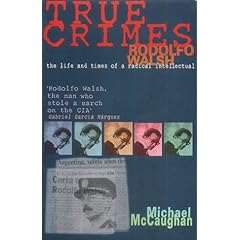
I've been reading a biography of Rodolfo Walsh (True Crimes: Rodolfo Walsh and the Role of the Intellectual in Latin American Politics by Michael McCaughan, Latin American Bureau 2000) which is also an anthology of his fiction and journalism translated into English. Not only has it been an interesting read, but it also has some eerily appropriate parallel themes with my current ponderings. Walsh was an Argentine writer and journalist, born of Irish ancestry and raised in a Catholic boarding school, wrote a In Cold Blood-like non-fiction work called Operacion Masacre, went to Cuba shortly after the Castro revolution in order to work in the news industry there and weirdly enough ended up intercepting a code from the CIA that gave away the location for the Bay of Pigs invasion, abandoned fiction to devote himself full-time to journalism and underground resistance work in the 70's once the political situation in Argentina really went down the drain, and was shot and killed in a shoot-out by the military in the middle of the street (his body was never recovered). He is counted as one of Argentina's 30,000 “disappeared” of that period. Isn't that weird, how you can sum someone's life up like that, in a couple of greatest-hits sentences? (I inevitably wonder what my own sentences will consist of...)

I haven't finished the book yet (I'm at the part where he gets really intensely involved in underground resistance), but there have definitely been some moments in the book that have given me pause and thus merit some reflection here. The short stories are excellent, particularly "Footnote" and "Esa mujer" (check them out). There's a lot of discussion in the book (as indicated by the subtitle) about Walsh's struggle with the role of the intellectual in society, which I found personally quite relevant... I feel uncomfortable about calling myself an “intellectual,” but I definitely read a lot, and like thinking about things that probably a lot of people would consider quite silly, such as “what is the role of the intellectual in society?” (After Barry-O's election and Georgie's reign, this question has been given a bit more attention.) I went to an expensive college, my parents are well-educated. I like reading fiction, writing fiction (goes without saying I need to do this one more), writing and talking about fiction. Yeah... I am pretty much a bourgeois intellectual.

I guess I struggle a lot with how relevant all of this is (the reading and writing and talking about fiction). I like doing a lot of other stuff to, outside of this—I like working with people, I like being with people, I like doing things that feel like they make more of a difference in a day-to-day sense. My job isn't super prestigious or super high paying or anything like that, but someone's got to hang out with these kids and give them something positive in their lives, you know? I dunno, I'll just say that I find it relevant and then leave it at that. My struggle (which I was reminded of again and again in this book) is finding a balance between these two things: the whole isolated hermetic ivory tower writer and intellectual tradition versus the nitty-gritty, down and dirty, involved in the world role. Is there a way to combine the two? Does it really come down to choosing one or the other? Is the role of books in my life destined to be restricted to a hobby, a sideline entertainment, or will it become a career? (The latter's up to me to decide, I guess.) Interestingly enough, in some of the interviews with family members and friends, a lot of them express frustration about Walsh's choice of journalism over politics... there's a certain attitude in their words of "oh, he could have been one of the greatest Argentinean fiction writers, he had so much potential, but then he went ahead and got involved in politics and justice." I don't think there's really a right or wrong choice; it's just a matter of the type of person you are... some of us are content, others of us are a little more scattered and need to explore different roles and careers in order to find that kind of satisfied fulfillment...

I folded over the upper-right corner on the page where Walsh is having a conversation with another young aspiring author, in his early 20's (this really hits home in terms of the theme of this blog):

“These are different times, Nicolas, and this is a time for a bigger undertaking. When you're trying to change important things, then you realize that a short story, a novel, aren't worth it and won't satisfy you. Beautiful bourgeois art! They taught us that it was the supreme spiritual value. But when you have people who gave their lives, and continue to, literature is no longer your loyal and sweet lover—it's a cheap whore. There are times when ... every spectator is a coward or a traitor. This might be a pain for the more intimate questions of the soul but that's the time we're living in.” (218)


You see this same question in a lot of Roberto Bolaño works. I just read La estrella distante (Distant Star), a 140-page novella that makes for a quick and thought-provoking one-day read. This book talks more about writers and poets than anything else, specifically one poet, Alberto Ruiz-Tagle, who gets involved with the Pinochet Regine by writing state-approved poetry in the sky. If you like Bolaño, you should definitely read this work. I never realized how influenced by Borges he was, either. I'm starting to see this as a common denominator in a lot of the stuff I've been reading or re-reading lately (Lolita, The Island of the Day Before). I don't want to give too much away about the book (part of its impact is being shocked by its unexpected development), but the novel deals with the same question discussed in the Walsh biography: what is the relationship between literature and real events? Is turning to literature when unimaginably violent events are taking place in your immediate world brave or just blind and stupid? The insightful New York Times book review of Bolaño's The Savage Detectives makes an important point:
What can it mean, he asks us and himself, in his dark, extraordinary, stinging novella "By Night in Chile," that the intellectual elite can write poetry, paint and discuss the finer points of avant-garde theater as the junta tortures people in basements? The word has no national loyalty, no fundamental political bent; it's a genie that can be summoned by any would-be master. Part of Bolaño's genius is to ask, via ironies so sharp you can cut your hands on his pages, if we perhaps find a too-easy comfort in art, if we use it as anesthetic, excuse and hide-out in a world that is very busy doing very real things to very real human beings. Is it courageous to read Plato during a military coup or is it something else?

Yeah... I'm just trying to figure stuff out, I guess. I am in a certain position of power and privilege, in the sense that I have choices of what to do with my life. And just like in Spiderman, "with great power comes great responsibility." So I am trying to figure what I want to do with my brain, and how I can find something to do with my brain that feels both worthwhile and valuable. So it goes.


Maybe getting glasses is the common denominator behind figuring everything out.