Showing posts with label Phillip K. Dick. Show all posts

Thursday, May 7, 2009

April Books


Deep Economy: The Wealth of Communities and the Durable Future

A very well-written, readable and well-argued book. McKibben basically argues that we need to redefine our understanding of classic economics: namely that more doesn't always necessarily equal better, not just for sustainable reasons (we're running out of resources on our planet) but for personal reasons (more stuff, bigger businesses and expanding economies aren't making us happier). It's an interesting argument and he follows through with it pretty well with practical suggestions on how we can refocus our energies on building more local economies and communities. I really enjoyed McKibben's discussion of behavioral economics and the science of happiness, two topics I find really interesting and know very little about. There are a few moments that are a little too "oh god, you are such an environmentalist from Vermont," like when he suggests giving bus drivers your personal mix CDs to slap on the stereo. Also, McKibeen seems to be writing for an audience that he automatically assumes is anti neoliberal and free trade, so if you're not, that might be a problem for you. (Disclaimer: it wasn't for me, I'm just trying to be fair and balanced here.) However, overall McKibben does quite a good job of making practical suggestions for how to make the world a better place and how to be more hopeful in general, which is a nice change from the more general "oh-god-we're-all-doomed" feeling of recent months.

The one part of the book that I keep summarizing and quoting to all of my co-workers and friends is the section where McKibben talks about the science of happiness. He asks the very interesting question of what was the time in our lives when most of us would say that we were happiest. For most people, they would say volunteering, with family, with friends, etc.... being around others. Being *out* of yourself and your chatty little head, and instead feeling like you're a part of something bigger than yourself. That really hit the nail on the head for me, and put into words something I'd been struggling to articulate to myself for a while now: what has brought me some of the highest levels of joy in my life was when I felt like I was "out of myself," part of something larger, whether in the hugeness of nature or within a community of people (like Los Embajadores in Tijuana), not as this self-internalizing super efficient/proficient utility machine.

Whether my enjoyment of finally having this particular feeling put into words actually leads to me doing or deciding something concrete remains to be seen. I think of my advisor's advice to me of why not to go to graduate school, at least not for literature, and it really rings more and more true for me by the day. He was like "travel! Get out in the world! Work with kids!" This summer, I'm gonna garden.

Rating: Read This Book Before You Die


Keep the Aspidistra Flying (George Orwell)

An enjoyable if not earth shattering read. Orwell is the master of succinct, perfect sentences. Along with watching "Revolutionary Road," this book definitely helped put me in a weird mindset about the whole settling down into a comfortable career and lifestyle deal, while thinking that you're this person who's "better" than everyone else around you. The happy ending feels a little forced; if Orwell had been truer to the tone of earlier parts of the book, the characters' fate would have been a lot darker. Orwell said in a letter that when he wrote it, "I was half starved and had to turn out something to bring in £100," which explains a lot. All in all, a nice fictional companion to "Down and Out in Paris and London."

Rating: Read This If You're An Orwell Fan


El Juguete Rabioso / The Mad Toy (Roberto Arlt)

Another book about a character whose life is really affected by money (namely his lack of it). I would have really dug this book in high school, a lot, and probably would have had a little bit of a crush on Silvio, the main character.

The Mad Toy took me a long time to get through, despite its 142 pages. I don't really know why. I don't exactly know what to make of this book. I'm not sure what the title refers to, for one. I guess "the mad toy" is Silvio himself, and the title refers to the way in which he often finds himself inevitably being used as "a toy" by people in power and by the mentors he consistently keeps seeking (and failing) to find. The final chapter (ominously titled "Judas Iscariot"), in which Silvio deliberately betrays a mentor/friend, can be understood as Silvio's attempt to subvert this feeling of always feeling like a plaything to others whims, and instead claim some agency of his own (at the stake of his friend, which is troublesome).

The first chapter is about Silvio as a young boy and his adventures in inventing amateur weapons of war and his life of crime as a book thief, smuggling encyclopedias and Baudelaire out of the school library. I love the sentence that he uses to introduce an anecdote about one of his inventions, copying the language of the pirate and Dumas paperbacks he loves. "A resounding adventure was that of my cannon, and happy am I to recall it." I like to repeat this phrase quietly to myself. It adds so much, narrating the events in our lives with a deliberate aesthetic style!

Needless to say, it says a lot about Silvio that his first career is as a book thief. He goes on to try working as a bookstore assistant, an apprentice airplane mechanic for the military, and a paper salesman, without finding much satisfaction. However, what seems to keep him going is his ability to aesthetically narrate his life and his surroundings, infusing it with what he experiences as an inexplicable joy:
I'm not crazy, one thing is certain, though... I know that life will always be extraordinarily beautiful for me. I don't know whether other people will experience the force of life as I do, but inside me there is joy, a full, unconscious kind of joy. Everything surprises me. Sometimes I have the feeling that it's just an hour since I arrived on earth, and everything is flaming new, fresh, beautiful. (150)


Silvio's goals by the end of the book are to "see glaciers and mountains and clouds." That sounds pretty good to me. The last sentence of the book is "I tripped over a chair, and kept going." It reminded me a lot of the last sentence of Catch-22. You jump out of the way of the whore's knife, life tangles you up and catches you off guard, but you gotta keep going.

Silvio's final mentor figure is the policeman who receives his confession/ratting out his friend, but doesn't arrest him. The wisdom he imparts to Silvio is "we obey a brutal law that's inside us. That's it. We obey the law of the jungle." A very true thing it is, human brutality. And yet it's not the only true thing. We feel as human beings, profoundly and deeply. What is it that drives some people to not just see life as a drudgery and a chore, life as 9-5, as a series of steps: college, job, marriage, children, retirement death? What is it that drives some people to make the conscious choice to love life, to see it as sweet?

I'd like to keep joy inside me. I'd like to aesthetically narrate my life, my day-to-day.

Love, poetry, gratitude toward life, toward books, and toward the world would send an electrical charge through the blue sinews of my soul.
It wasn't me, but the god inside me, a god fashioned from pieces of mountain, forest, sky and memory.
(123)


Rating: Read This Before You Die


When Things Fall Apart: Heart Advice for Difficult Times by Pema Chödrön

A self-help book written by a Buddhist Canadian nun. I first heard of this book when my yoga teacher read aloud a passage at the end of one class that really connected to me. I recognized a lot of her advice from stuff my counselor gave me to read way back in junior year. She talks a lot about loving compassion, the importance of breathing in and out, exercising non-judgment. It's not just all theoretical, there's a lot of practical advice in her. All in all, a very wise book by a very wise lady. Even if you're not in a time of your life where things are falling apart, there's definitely some stuff in here that you could use.

Rating: Read This Book Before You Die

In April I also read Phillip K. Dick's Flow My Tears the Policeman Said and Ubik, both good reads if you're a Dick fan (hee), but not necessarily vital. I also read Faulkner's The Wild Palms, which hopefully I'll be able to devote an entire post to this weekend. And that was my April.

Tuesday, March 31, 2009

On Learning


I've been thinking a lot these days about the value of curiosity. During our early getting-to-know-you conversations, I asked Corey how he would describe himself in one word, and he said, "curious." (I didn't know my one word at the time, but now I think it would have to be "dreamer.") But then I just think about this innate curiosity within me and damn, maybe I am just stupid and naive and this is going to get me into trouble, but the joy of wandering lost through the PQ sections of the SE stacks in the Hauser Library, writing book reviews in my stupid blog, rambling with my co-workers about Borges, or just reading, reading, reading, underlining passages, thinking, writing--it brings me a great joy I don't get anywhere else. No one can take that curiosity away from me, you know? It's in me, it is me. I'll always have it. If I have a way to use it, to the best of my ability, I will be happy. And all these ridiculous badges that supposedly constitute prestige and success can never hold a candle to that, ever.

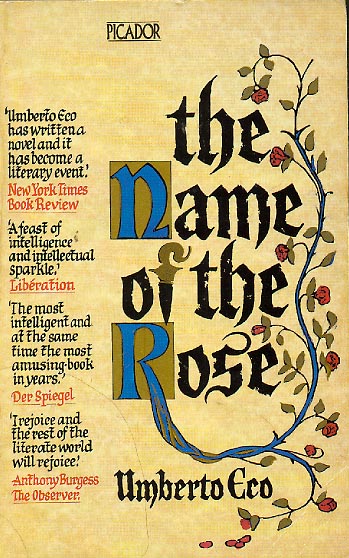
This has been an introspective year for me so far. Having lots of time on the Max to read will do that for ya, I guess. One of the things I've been thinking about lately is the role of books in my life. I just finished Umberto Eco's The Name of the Rose, one of the most glaring titles on my list of Books I Really Should Have Read Already, Don't Know Why I Haven't, Really. In this case, I think it's for the best I waited this long. I definitely got a lot more out of this book with an undergraduate degree.

For one thing, I've read a lot more Borges now than I had in high school, which makes certain aspects in TNOFR like the blind librarian and the labyrinth in the library stand out a lot more (read more about the connection between Borges and Eco here). The introduction is puro Borges and Nabokov, especially in the fictional translator's cheerful pronouncement that the volume lacks any relevance for our present day. Another benefit of my undergraduate education are the lit theory classes, which makes the book's discussion of the roles of signs a lot more interesting. The part where William identifies the abbot's horse (by means of the tracks he left behind in the snow and the flustered monks pursuing him for example) is really ingenious, demonstrating (in William's view) how the universe speaks to us quite clearly through signs. The main question that he (and Borges, and Nabokov) grapple with is how to interpret those signs—is there any order to them, other than the flimsy order imposed by our own minds to make our surroundings seem meaningful? (Probably not.) What is the value of interpretation? Can it ever arrive at any definitive truth, or will it just go on and on forever? (Probably yes. But that's not to say that some interpretations are more valuable than others—read Eco's thoughts on this here, an interesting talk that may be a little confusing if you haven't read his books.)*

The other thing I found unexpectedly intriguing in TNOTR was its discussion of “simple people.” I'd just re-read “Siddhartha” for the first time since high school a couple of weeks ago, and Hesses uses the same term, to refer to people who are purely controlled by their desires. That is to say, people who go through life controlled by what they want: get a job, get money, get married, get a house, get a big TV, get a nice car, and so on. Most of the people in the world are like this—not that there's anything wrong with that. It is vital to note that a major part of Siddhartha's enlightenment is that he eliminates his judgment for the “simple people,” and instead of thinking that his way is superior or vice-versa, he simply accepts that they are different. It is not wrong to be one of the “simple more” any more than it is better to be someone like Siddhartha's—they're just different. The ending of “The Curious Case of Benjamin Button” reiterates the same message: “Some of us are dancers, some of us are mothers, etc,” Brad Pitt intoned solemnly in a voice-over. Or as my Grandma Mary is fond of saying, “We're all different, Julie—different strokes for different folks.”

In The Name of the Rose, the “simple people” are discussed in context to how words affect them, in the sense that they can be more easily manipulated by language. People like William are more akin to a class of readers, because he's constantly trying to read the signs around him, as opposed to accept them at face value. Not to sound incredibly arrogant and place myself on the same level of Sherlock Holmes, but I like to think that it's the same drive in me that inspires me to plough through an entire Phillip K. Dick book in one day, or stubbornly struggle with Mario Vargas Llosa's La Casa Verde. I can think of a lot of people who would think it was pretty crazy to spend my time trying to read Ulysses and La Casa verde. In a way, it is kind of silly. But to me, it feels incredibly valuable and important and precious and there is really no other way I'd rather spend my hours here on Earth: thumbing through these books, inhaling them into their brain, thinking about their words, wondering about their effects and their relation, among each other, among societies, and with me. If I had to describe myself in one word, it would be “dreamer.” I'm just not settled yet, you know? A lot of us aren't. Me, I have little clouds floating out of my ears...

I've been trying to think of a way to explain why books are so personally appealing to me, mainly because my co-workers keep asking me how I liked majoring in literature, and I always respond immediately that I loved it, that it was great, and then my answer to their follow-up question of “why?” is always hopelessly confabulated. Here's one of the reasons I came up with: I was thinking that one of the things you will never be able to do while you are alive on this earth as a human being is to see yourself through another people's eyes. You are always going to be you, indefinably and inexhaustibly you, tied to the ego of your self, your memories, your desires, all the little building blocks that construct you as a person (many of which you are probably not even aware of—maybe that's what life is for, trying to figure out what those tiny little building blocks are). As close as I am to people like my sister and Corey, I'm never going to know what it's like to *be* Corey—to be inside his head, to see the world as he sees it, to know what he's thinking at any random moment. There's this really interesting part in Wizard of the Upper Amazon where during his shaman training, the main character drinks ayahuasca in many ceremonies and learns what it's like to be different animals: anacondas, jaguars, pink river dolphins. At one point he goes inside the mind of everyone in the tribe, and this experience helps him become an especially emphatic and alert healer. Thus, therein lies some of the magic of reading. On one level, reading purports to allow you to “see” the world through another's eyes. I will never know what it's like to be an Italian monk in the 13th century, trying to solve a seemingly unsolvable mystery. But goddamn, I probably know more now that I would have if I'd never read it. Reading is a gateway, a vehicle to different experiences that I otherwise would never be able to have.

Another joy of TNOTR was recognizing myself in the characters. Yes, I definitely cackled to myself, nodding vigorously in recognition as I thumbed eagerly through the pages—yes, these crazy library people, “men who live among books, with books, from books”--these are my people. As one of the monk puts it, “It's true. We live for books. A sweet mission in this world dominated by disorder and decay.” (112) In contrast to the “simple” people, the monks are presented as the “learned' population, living the so-called life of the mind. (I'm glad that my experience of living the life of the mind didn't end with me drowning in a barrel of pig blood, though it came pretty close at times.)

This discussion of having a certain privileged “learned” population who are particularly good at interpreting makes me slightly uneasy, because to me it automatically raises the question of authority: what happens if authoritative interpretations, as designed by this select group, gets in the way of individuals interpreting for themselves? I'm not necessarily thinking of grad school students taking over the world. In one provocative section, Adso discusses learning as something for the few and elect - “Learning is not like a coin, which remains physically whole even through the most infamous transactions; it is, rather, like a very handsome dress, which is worn out through use and ostentation. Is not a book like that, in fact? Its pages crumble, its ink and gold turn dull, if too many hands touch it.” (185) Comparing learning to a book that can grow shabby, decayed and eventually crumble from overuse sets up the biggest danger in the end of the novel—namely, people who think that it's better off if certain kinds of learning (found in specific books) are kept solely to themselves, even if it meant having to kill to keep it secret. William has an interesting monologue in which he discusses the problem of giving learning to the simple:

"The simple have something more than do learned doctors, who often become lost in their search for broad, general laws. The simple have a sense of the individual, but this sense, by itself, is not enough. The simple grasp a truth of their own, perhaps truer than that of the doctors of the church, but destroy it in unthinking actions. What must be done? Give learning to the simple? Too easy, or too difficult. The Franciscan teachers considered this problem... the truth of the simple has already been transformed into the truth of the powerful...How are we to remain close to the experience of the simple, maintaining, so to speak, their operative virtue, the capacity of working toward the transformation and betterment of their world?"

Since for William, “the experience of the simple has savage and uncontrollable results...” his solution is that “we must be sure that the simple are right in possessing the sense of the individual, which is the only good kind.” (205) I can see a lot of sense in that. Being a living individual is a unique, singular experience. I will never know what it's like to be you, you will never know what it's like to be me. That's something that really shouldn't get lost--this understanding and appreciation of our unique, singular existence. Nobody quite like you, with your thoughts-visions-dreams, has ever existed, nor will ever exist again. Even if the kids I work with every day don't turn out to be graduate students or university professors, they nontheless deserve to think of themselves as *individuals* who can decide for themselves what they want. They don't have to go into the Army just because that's the authorative interpretation of what they should do with their lives imposed upon them--they are individuals with unique personalities and thus unique decisions (I think you could argue that authorities try to erase this, in order to encourage only one interpretation). I'm probably not making this point as clearly as I want to... but in summary, this book helped me figure a couple of important things out, in unexpected ways. I think I'm slowly but surely coming to terms with my own decentered nature, my detective-like character, my unsettledness, and I'm slowly but surely beginning to learn how I can use those qualities as a gift, not just to better others, but also myself. I may not be any closer to creating any more order in this world, but at least there is the smallest semblance of more order in this poor head of mine.

“Learning does not consist of knowing what we must or we can do, but also of knowing what we could do and perhaps should not do.” (97)

* There's an absolutely crazy anecdote in this talk straight out of Philip K. Dick, where Eco describes an incident in which he found himself living a scene straight out of TNOTR: thumbing through a beat-up old book in his library, its pages stuck together in a gluey fashion, and realizing it was this lost, incredibly valuable translation of Aristotle. This really blew my mind. There is something crazy going on with this whole life-imitates-art business...